23 April 2006

In a Swamp, and Calling for Help

I've wandered out into the morass of Met. Z and find myself wondering how I got here. Looking back, I see the following. (What follows is a 'map into the swamp'. You might just wish to surf in fresher waters.)

[i] I was writing a review of a volume (OSAP Winter 2003) in which Dan Devereux's paper appeared on the relationship between Zeta and Eta. (That review should be coming out shortly in BMCR.) It was not that I was looking to find flaws in that paper. Devereux's paper involved some relatively close and interesting matters of interpretation, which it was not possible to discuss in the review; therefore, I took up some of them here.

[ii] I looked at two sorts of arguments that Devereux put forward, involving (i) redaction criticism and (ii) philosophical interpretation. I found Devereux's arguments interesting, as I said, and worthy of serious consideration--indeed, that is why I spent time on them. Yet it seemed to me in the end that all of these arguments were unpersuasive, and I gave my reasons why. (By the way, dear reader: I rely on you to point out where I am wrong. Do not forget that you would do me a favor by refuting me.)

[iii] Since Devereux had relied frequently upon Burnyeat as an authority, I looked briefly at Burnyeat's Map of Metaphysics Z. (I had read the Map several years ago, when it was a lengthy paper; I had not previously looked at it in book form.) I found that, as regards redaction-criticism, one of the unsound arguments that Devereux had drawn from Burnyeat (about en allois) had also been endorsed by Burnyeat. But I found that another argument (about the significance of the H1 summary) had effectively already been replied to by Burnyeat.

[iv] As regards philosophical interpretation, on the other hand, a difficulty in Burnyeat's general approach appeared to me, which I've tried to clarify in the last few posts. The problem has to do with why Aristotle spends the bulk of Z examining perceptible ('sensible') substances. Here is another way of putting the problem.

[v] As is well known, Aristotle describes what he is doing in the Metaphysics in two ways. He describes it as the study (i) of being qua being, and (ii) of imperceptible, separable substances. Now, as regards (i), it would seem misguided to restrict oneself to perceptible substances only, as this would be to 'cut off only a part of being' and study only that, rather than all of being. And, as regards (ii), clearly, the study of perceptible substances is not the study of imperceptible substances.

[vi] It is not clear to me that Burnyeat's interpretation can respond to this difficulty: Burnyeat says that Aristotle introduces the form-matter distinction in Z to reply to logicizing philosophers (as we may call them); but then we are left wondering how Aristotle's examination there of substances as having matter counts as metaphysics rather than physics. I used Burnyeat remarks on Lambda 1-5 to show that he does not succeed in explaining this.

[vii] The difficulty, in my view, becomes even worse, when one considers that Burnyeat argues in his Map that Zeta-Eta-Theta were written as a unit, that Lambda was tacked on later, and that it is, so to speak, extrinsic to those other books. It is unclear how, on this view, Aristotle in Z could be doing 'second philosophy for the purposes of first philosophy'. If there is no immediate and intended application of the results of Z to imperceptible substances, then how is it first philosophy?

[viii] I suppose Burnyeat could say that, on his interpretation, the conclusion 'form is substance' is exactly what is needed for the study of imperceptible substances--that is, Z establishes that substances can exist as pure forms, in establishing that form (alone) is substance. But then I wonder why Aristotle would take Platonizing or logicizing philosophers as his target in arguing for this sort of a conclusion. (Is that what they would find difficulty with?) Or, if you say that there is some special notion of form, not shared by them, that Aristotle wants to arrive at in Z, derived from the way that that notion gets used in the Physics--then, once again, the problem arises of how Z is different from physics. Also, it's not clear that there is any 'special notion of form' in Z except insofar as form is considered in its relation to matter--and yet then it appears to be a difficulty that Burnyeat wants to treat Z7-9, where form in its relation to matter is given thorough consideration, as an incongruent interpolation.

[ix] We could of course say that Aristotle is confused about his own distinction between first and second philosophy, or that the distinction doesn't amount to much in the end.

[x] And perhaps these are illusory problems, something that is hanging me up momentarily and that isn't very serious. My difficulties could easily be based on a misunderstanding. I present them simply as something troubling me for the moment.

[xi] Finally, when discussing Devereux on Z3, I proposed my own interpretation of the famous reductio there. I said that Aristotle was wishing there to draw a distinction between two senses of 'hypokeimenon'

(i) where the subject of predication is what is predicated of it (hypokeimenon 'as form' or 'as composite'); and
(ii) where the subject of predication is not what is predicated of it (hypokeimenon 'as matter');
and I said that the reductio of Z3 was meant to drive home the point that any intelligible use of (ii) presupposed a prior use of (i).

[xii] This suggestion (which, by the way, corresponds nicely to the back reference about the hypokeimenon, at Z 13.1038b2-6, and receives confirmation from that back reference), leads to an appealing simplification of the structure of Z, which is this.

[xiii] Of the four marks of substance which Aristotle presents at the beginning of Z3 (hypokeimenon, to ti en einai, katholou, genos), it is clear that Aristotle wishes to deal with the last two negatively, in order to reject them. What really needs to be explained, then, is Z3-11, which my distinction does:
Z3: distinction in senses of hypokeimenon
Z4-6: hypokeimenon as form (to ti en einai, called by Aristotle 'form')
Z7-9: hypokeimenon as composite and as proximate matter
(Z10-11: ancillary discussion of definition)
[xiv] My post pointing out that 'form' and 'matter' are not used by Aristotle in Z4-6 was meant to support this interpretation: 'form' is not used in Z4-6, I would suggest, because hypokeimenon 'as form' is precisely what Aristotle understands as the to ti en einai and is discussed through that phrase; and 'matter' is not used, because his discussion of hypokeimenon 'as (proximate) matter' and 'as composite' begins at Z7.

Now that I know where I am in this swamp, I'm radioing to be air-lifted out.

22 April 2006

The Metaphysical Study of Perceptible Substance

Here's the problem. Aristotle's official characterization of 'first philosophy' is the study of form as truly separable from matter. Yet ZHQ and also the first five chapters of L are about forms in matter. So how do these count as 'first philosophy' (metaphysics) rather than 'second philosophy' (physics)? One would like to say that there is some way of studying form-in-matter that counts as metaphysical.

But explaining this proves difficult to do.

One may see this in Burnyeat's discussion of L .1-5 (see Map, pp. 133-4). He rejects the view of Ross and others that these chapters are 'physics'. And yet he seems to give no clear reason why these are not physics, as the following analysis shows.

Here it is relevant to recall the evidence of Z11 that there is a first-philosophical way of studying sensible substantial being as well as a second-philosophical way.
That is exactly what is at issue. What is the difference?
The statement 'Sensible substantial being is liable to change' (L .1.1069b3) can be read as an invitation to study change. That is a topic of Aristotelian physics. But the statement can also be read as an invitation to study the type of substantial being we find in the sensible world-- changeable substantial being as opposed to the unchanging type that first philosophy aspires to understand...
But presumably, as Aristotelian scientists, we appropriately study change by studying the changes of substantial beings. Also, if we are not studying the 'unchanging type' of beings which are the proper object of first philosophy, then how are we studying first philosophy?
The way to read the early chapters of L is as a first-philosophical use of the factors invoked in Physics I to explain change (matter, form and privation).
Indeed. But what is this 'first-philosophical use'? This has not been explained.
These now reappear as the principles that explain the substantial being of sensible, hence changeable, substantial beings.
I don't understand. Is it that we should study these 'changeable substantial beings' as if they don't change? Or study them when they are not changing? What would that be? And in any case, Aristotle devotes much attention in the Metaphysics to how they come into and out of existence.
Just this is what happened when H1 resumed after the summary. That passage continues with a reference to the physical works (1042b8:e)n toi=j fusikoi=j), which confirms that H1 itself is not conceived as a contribution to physics.
We may grant the fact, but what is it for H1 not to be 'conceived as a contribution to physics'? (Also: Isn't it a fallacy to argue that any work that refers to the Physics isn't of a piece physics? Compare: "The Politics refers to the Ethics, which shows that it is not conceived as a contribution to ethics." Also: note too that here Burnyeat does grant that H1's discussion of perceptible substance resumes an earlier one.)
Similarly, when L 1 announces a comprehensive study of all three ranks of substantial being (sensible and perishable, sensible and eternal, unchanging and non-sensible), and says that because the first two involve change, they are the subject-matter of physics, this does not mean that are L 1-5 conceived as physics rather than first philosophy.
Granted, once again. Yet, once again, we still don't know what it means to study the objects of physics but not in the way that physics does.
L defined its task as that of finding the principles and causes of substantial beings (L 1.1069a18-20), where 'substantial beings' (we soon learn) covers all three ranks of substantial being enumerated at 1069a30-b2. If L starts from sensible substantial beings, this is because they are better known to us than the other two ranks of substantial being (cf. Z 3.1029b3-12).
To be sure; but, still, in what way is its 'starting from sensible substantial beings' distinct from physics?
The point of reminding us, here and at the beginning of L 6.1071b3, that the first two ranks of substantial being are studied by physics is that, since they are also studied by physics, the reader can be expected to come to first philosophy already familiar with matter and form and other factors in the Aristotelian analysis of change. Compare A3.983a33-b1, which says that the four causes have been sufficiently explained in the Physics; the knowledge we are assumed to have is now to be put to a new use.
Again, that's not controversial. But what is that new use? Once again, this is unexplained.
Readers versed in Aristotelian physics can be expected also to be familiar with the contrast between the perishable substantial beings of the sublunary world and the imperishable, eternally circling heavens. Crucially, they wil have the understanding of human psychology which is presupposed in the attempt of L 7 and 9 to extrapolate to the mind of God. First philosophy is first in order of understanding, but last in the order of learning.
But now we are on to 'first philosophy' in the proper sense, without its ever having been explained to us how L 1-5 did not count as physics.
To put it another way, the task of finding the principles and causes of all three ranks of substantial being has the universal scope assigned to first philosophy at the end of E4.1028b3-4: to find the principles and causes of being itself qua being.
But if we append, in front of a treatise, "What follows should be understood as having universal scope", have we thereby turned it into metaphysics? That's a bit too easy, I should think. Not that this would be the case anyway:
True, the rubric 'being qua being' is not found in L. But nor is it found in ZHQ. Instead, both Z1 and (more briefly) L 1 use the focal analysis of being to explain why the inquiry will concentrate on substantial being rather than the dependent categories. Because the dependent categories are dependent, it is substantial being that explains the rest. The study (to coin a phrase) of substantial being qua substantial being is the first part (cf. 1069a20: prw=ton me/roj) of the universal study of being qua being. It is this part that is begun, but not completed, in ZHQ, begun and completed in L. From beginning to end L is first philosophy.
I can't say that I'm convinced.

First and Second Philosophy

I raised the question in an earlier post: If Aristotle, in Met. Z, appeals to the form/matter distinction in order to reply to Platonist-type philosophers with a taste for the abstract, wouldn't we expect him to be using that distinction to draw attention to the importance of matter, not form? After all, form is what Platonists truck in.

Perhaps you gathered that, underlying my question, was a concern that a usual way of setting up Z --Aristotle is trying to figure out what substance is, and his answer is that it is form--was off the mark; that Aristotle isn't asking this question or answering it in that way; that we were missing what he was truly interested in.

Someone might say in response: "If his point in introducing the form/matter distinction was to draw attention to the matter, then his discussion in Z would be no more 'second philosophy', that is, physics. But it is supposed to be 'first philosophy'. And it's by drawing attention to the form that his discussion counts as first philosophy."

But I don't see how. If discussions appealing to matter count as second philosophy, why not also discussions appealing to form-in-matter? Or, if you say that it's the fact that a discussion of form-in-matter leads up to a discussion of separate substance, form on its own, which makes it 'first philosophy', then I can say, just as well, that it's the fact that a discussion of matter leads up to a consideration of form on its own which makes that 'first philosophy'.

In fact, this whole question of the distinction between 'first' and 'second' philosophy seems confused to me, as I'll explain in my next post.

21 April 2006

Perceptible Substances All Have Matter

"But now let us resume the discussion of the generally recognized substances. These are the perceptible substances, and perceptible substances all have matter."

nu~n de\ peri\ tw~n o(mologoume/nwn ou)siw~n e0pe/lqwmen. au{tai d' ei0si\n ai9 ai0sqhtai/: ai9 d' ai0sqhtai\ ou)si/ai pa~sai u3lhn e1xousin.:
Thus H 1 1042a24.

e0pe/lqwmen
might mean 'let us start with' (as Burnyeat wishes to take it: Map 63). But it can alternatively mean 'return to' (cf. NE 1172b8), as Ross seems to understand it. Suppose it does and that we read this in conjuction with the methodological passage at the opening of Z 4 (transposed now typically to the end of Z3):
Some of the perceptible substances are generally admitted to be substances, so that we must look first among these. For it is an advantage to advance to that which is more knowable. For learning proceeds for all in this way-through that which is less knowable by nature to that which is more knowable; and just as in conduct our task is to start from what is good for each and make what is without qualification good good for each, so it is our task to start from what is more knowable to oneself and make what is knowable by nature knowable to oneself. Now what is knowable and primary for particular sets of people is often knowable to a very small extent, and has little or nothing of reality. But yet one must start from that which is barely knowable but knowable to oneself, and try to know what is knowable without qualification, passing, as has been said, by way of those very things which one does know.
Then it would be natural to take the above to be saying: we need to consider each of the marks we have mentioned (hypkeimenon, to ti en einai, katholou, genos), with a view, first, to how they work as regard perceptible substances. But these have matter. Thus we must consider how they work as regards things with matter.

That is, the above methodological passage gives Aristotle's reason for introducing the form-matter distinction. It answers the question: Why does Aristotle introduce the form-matter distinction in Z? And it does so consistently with what we should antecedently expect.

And then, as I remarked in an earlier post, chs. 7-9 do not appear to be out of place. They are the commensensical deployment of the form-matter distinction to perceptible substances insofar as they come about by art, nature, or spontaneously.

An Interesting Pattern

The following is a chart of the frequency of occurrence of two words in Met. Z 3-17. The blue numbers represent Z 4-6, and the red numbers represent Z 7-9. Can you guess what words these are? (I give the answer in the comments box.) Also, what lesson, if any, should we draw from this?

1029a 11 2
1029b 0 0
1030a 0 0
1030b 0 0
1031a 0 0
1031b 0 0
1032a 3 1
1032b 4 6
1033a 5 2
1033b 2 7
1034a 4 6
1034b 2 3
1035a 12 12
1035b 8 4
1036a 6 3
1036b 3 6
1037a 9 0
1037b 3 0
1038a 2 4
1038b 1 0
1039a 0 1
1039b 2 0
1040a 0 0
1040b 1 1
1041a 0 0
1041b 3 1

Substance Over Form

Suppose you are an Aristotelian. I am a philosopher with Platonist tendencies, and I approach you, all excited, that I have developed a new theory of pleasure and pain. "Pleasure and pain," I say, "are actually ratios of numbers. If the ratio is greater than 1, then it is a pleasure; but if it is less than 1, then that is a pain."

As an Aristotelian, in considering this theory, you might very well object that it was deficient in very basic way, such that it could not possibly be a correct account, yet, of pleasure and pain in living animals. "Your theory, if correct," you might say, "would be an account only of the 'form' (eidos) or definition (logos) of pleasure and pain. But, if you wish to give an account of these as they occur in living creatures, you must also explain their 'matter' (hule). That, indeed, is what distinguishes a natural philosopher from a mere dialectician or logician--attention to the matter. After you propose also an account of the matter, then we might begin to evaluate the correctness of what you say."

I tell this simple tale (adapted of course from De Anima 1.1 403b) because, to my mind, it establishes an 'antecedent probability' for the interpretation of Metaphysics Z, with which, it seems to me, Myles Burnyeat's famous account is prima facie at odds.

Recall that Burnyeat holds that Z consists of four 'non-linear' and non-cumulative discussions, each of which examines one of the marks for substance set down at the beginning of Z 3 (hypokeimenon, to ti en einai, katholou, genos). According to Burnyeat, each of Z's four discussions is carried out on 'two levels' , starting with one of these marks considered as proposed in a merely 'logical' way (the first level), and then moving on to a consideration of the mark in terms of the form-matter distinction (the second level).

It is a familiar enough view that, in the Metaphysics, Aristotle goes beyond concepts he had used in the Organon by deploying the (supposedly) later form-matter distinction developed in the Physics and in his other writings on natural science. What is distinctive about Burnyeat's version of this thesis, I take it, is that Burnyeat understands Z as, so to speak, polemical rather than merely developmental: he proposes that its discussions are pointedly directed at Platonists, or philosophers with a similar outlook, who consider that one should do metaphysics relying solely on notions in logic or mathematics. (Burnyeat quotes Philip Merlan to bring home this point: "Whenever we use the word 'metaphysics', we should hear its Platonic or anti-Platonic overtones: metaphysics and not metamathematics", 81n6.)

What is especially appealing, I think, about Burnyeat's understanding Aristotle's target in this way, is that it seems true to life. In our own time, for instance, we are familiar with major philosophers, metaphysicians, who similarly believe that the right way to approach questions of ultimate reality is to ask what the world must be like for logic and mathematics to be possible.

But to my mind there is a basic difficulty in Burnyeat's interpretation, which becomes clear if we pose the question: Precisely why does Aristotle use the form-matter distinction against these Platonists and 'logical' metaphysicians? Why reply to them in that way, rather than in some other way?

I don't see that Burnyeat gives a satisfactory answer to this. He speaks as if the form-matter distinction is simply a kind of philosophical wringer which all theories must pass through (while admitting that Aristotle does not deploy the distinction in major treatises such as the Ethics or Politics).

[The procedural peculiarities of Z] are Aristotle's solution to the problem of how to encourage his readers to start at the right place, with reflection on form and matter as the first principles of physics. (81)
But why is this the 'right place'? Burnyeat doesn't say. Or, if he does give an answer, it has to do with the result which, according to Burnyeat, Aristotle wishes to draw from his deployment of the form-matter distinction, namely, that 'substance is form':
From the perspective of physics, substantial form is nature as the internal principle of change and stability characteristic of natural things. The very last sentence of Z brings us back to substantial form in nature... (7)
That is to say, if Burnyeat gives an answer to the question of why Aristotle introduces the form-matter distinction in Z, it is that Aristotle wishes to force the conclusion that substance is to be identified with his notion of form.

But the point I wish to make--to go back to the tale I told at the beginning of this post--is that the antecedent probabilities work in another direction. It is antecedently likely, I consider, that, in a discussion between Aristotle and a merely 'logical' philosopher, if Aristotle introduced the form-matter distinction, this would be, rather, to make a point about matter, not form. Isn't it precisely what is wrong with a merely 'logical' account, that it considers the form, and only that? Antecedently, we'd expect that Aristotle's lesson, in Z, would be the opposite of what Burnyeat proposes: that matter must be considered, too, in any correct account of substance.

19 April 2006

The Significance of the H 1 Summary

This may be my last post on Devereux's redaction criticism; perhaps enough is enough.

Yesterday I drew attention once again to Devereux's argument that Z 3 is a later addition to Z, because the summary in H 1 does not mention or recount the dialectical discussion of Z 3. Yet this argument does not hold up under scrutiny, as even a brief examination of the relevant passage from H 1 will show.

That passage begins by stating a theme of the Metaphysics which recurs repeatedly from almost the beginning of that treatise. Moral: the summary is not meant to be simply a review of Z:

We have said that the causes, principles, and elements of substances are the object of our search.
It then gives a large amount of space to mentioning the 'commonly agreed upon substances'. These were not part of the argument of Z. Moral: there is a disproportion between the summary, and the content of Z; it would be unsound to argue from the size or significance of a mention in the summary, to the size or significance of the corresponding treatment in Z:
And some substances are recognized by every one, but some have been advocated by particular schools. Those generally recognized are the natural substances, i.e. fire, earth, water, air, &c., the simple bodies; second plants and their parts, and animals and the parts of animals; and finally the physical universe and its parts; while some particular schools say that Forms and the objects of mathematics are substances.
Then it turns to the considerations which occupy the bulk of Z. It mentions 'essence' (to ti en einai). Aristotle's discussion of this in Z occupies chapters 4-6. This summary simply mentions that essence is regarded as a candidate for substance; it does not summarize any argument from those chapters or even say what conclusion was reached by those arguments. Moral: we have no reason to think that the similar mention here of 'substratum' (hypokeimenon) does not stand, likewise, for a lengthy discussion in Z:
But there are arguments which lead to the conclusion that there are other substances, the essence (to ti en einai) and the substratum (hypokeimenon).
Next we have simply a mention of the two other criteria for substance (genus, species), and an explanation of why other things (Ideas, definition, formula) were dealt with as well, as related to these. Moral: no arguments of Z are presented in this summary.
Again, in another way the genus seems more substantial than the various species, and the universal than the particulars. And with the universal and the genus the Ideas are connected; it is in virtue of the same argument that they are thought to be substances. And since the essence is substance, and the definition is a formula of the essence, for this reason we have discussed definition and essential predication. Since the definition is a formula, and a formula has parts, we had to consider also with respect to the notion of 'part', what are parts of the substance and what are not, and whether the parts of the substance are also parts of the definition.
Next we do have a definite conclusion being mentioned, but this is only in order to defer until later (books M and N) a particular discussion:
Further, too, neither the universal nor the genus is a substance; we must inquire later into the Ideas and the objects of mathematics; for some say these are substances as well as the sensible substances.
Thus, there is simply no basis in this summary for concluding that Z 3 was not originally part of Z.

But this point was made already by Burnyeat in his Map of Metaphysics Z. In the chapter on 'Signposts', after reviewing the correspondences between the summary (and drawing lessons from it, although not quite the same lessons as those I draw above), Burnyeat at first observes:
There are, however, two apparent omissions (apart from Z7-9 and Z12) that call for explanation. The discussion of the subject in Z3 is not separately recorded, and the summary does not mention Z17.(63)
But then he later argues, clearly rightly:
If Z3 is cited without express mention of its rather brief discussion of substantial being as subject, whey complain? The summary reminds us that subject [hypokeimenon] was discussed, but the only thing more to say would be what conclusion was reached, and positive conclusions are something the summary avoids.(65)
Strange that Devereux in his article should frequently cite Burnyeat's Map as an authority and yet insist, against Burnyeat's commonsense point, and without giving an argument in reply, that there is a significant omission here.

18 April 2006

Puzzlement for Me

I'm very puzzled now. Recall Devereux's argument in redaction criticism, which I posted here:

Scholars have argued...that chapters 7-9 and chapter 12 are 'later insertions' in Z since (i) they are intrusive in their context and (ii) there is no mention of them in the summary at the beginning of H. Further, in H 3 Aristotle says that it was shown elsewhere--not in Z or H--that forms are neither generated nor produced (1043b16-18). But Z 8 contains an argument for this thesis, so it seems that this chapter was not a part of Z when the reference in H 3 was written. These details suggest that there was an early, 'first' version of Z which is summarized at the beginning of H, and a later expanded version containing the 'inserted' chapters, Z 7-9 and Z 12.
This argument largely rests on the presupposition that in H 3, when Aristotle wrote the phrase, "in other discussions", e)n a)/lloij, then (if he really did write this) he could not have meant some other book in the Metaphysics: according to Devereux, he could not, from within H, have referred back to something already existing in Z by using that phrase. I pointed out that this argument was almost worthless. But I didn't do the obvious thing then, namely, check for other uses of e)n a)/lloij in the corpus. I argued on the basis of antecedent probabilities and analogies.

Well, I checked just now, and it turns out there are at least two other examples where Aristotle uses that phrase in one book of the Metaphysics to refer to something in another book. At 1017b9, in 5.8, that phrase is used to refer to 9.7 (o&te de\ dunato_n kai\ po&te ou1pw, e0n a1lloij dioriste/on))) and at 1046a5, in 9.1, that phrase is used to refer to 5.12 (o3ti me\n ou}n le/getaipollaxw~j h( du&namij kai\ to_ du&nasqai, diw&ristai h(mi=n e0n a1lloij)

So Devereux's argument is entirely worthless, isn't it?

What's bizarre is that Myles Burnyeat endorses the argument also in his Map of Metaphysics Z. In a section entitled, "Various reasons for thinking Z 7-9 a later insertion" he writes:
[iii] H3.1043b16, refers to Z8 as 'in another discussion' (e0n a1lloij). This proves the one-time independence of Z7-9 provided H is continuous with Z, which there is anyway good reason to suppose.
'Proves' is a strong word. I wonder if the appearance of proof comes from Burnyeat's argument having the character of tautology: if H is continuous with Z, then of course a reference to part of Z as if it were not continuous would show that that part was not within Z. That's true 'by definition', given an appropriately strong meaning of 'continuous'. On the other hand, one might just as well say that the H3 reference shows that Aristotle never regarded that discussion (or indeed any discussions in the Metaphysics), as 'continuous' in that very strong sense.

Epicene 'They'

One needn't look to Shakespeare or Jane Austen for examples. These are from an impeccable source:

It is true that no student is ready for the grand project of first philosophy until they have a thorough grasp of natural science or 'second philosophy', including the psychology of the De Anima.

A careful reader should be left gasping with surprise when they find that Z's first explicit enunciation of the thesis that primary substantial being is form occurs in a parenthesis (1032b1-2) about artefacts.

A Summary Objection

Over the next couple of days, I aim to post a few follow-up comments to my discussion of Dan Devereux's essay and Met. Z 3.

Here's a small point about H 1 . As I've mentioned and you know, that chapter begins with a summary. From the character of its first couple of lines, it is perhaps even meant to be a capsule summary of the entire argument of the Metaphysics up to that point.

Devereux takes it to be a summary of Z, and he thinks that what that summary leaves out tells us something definite about a supposed early draft of Z, written at roughly the same time as H. (This is his 'redaction criticism' of books Z and H.) In this post I'll simply quote the relevant comments from Devereux. In a subsequent post, I'll say why his view seems puzzling to me. Frankly, I can't understand the demand that Devereux wishes to place on this summary. To me it seems unreasonable. Here are his comments:

At the beginning of H 1 Aristotle pauses again to take stock: he mentions the four candidates [sc. for substance], and goes on to say that three of them, the essence, the universal, and the genus, have been discussed (1042a12-22). Surprisingly, there is no mention of a discussion of the underlying subject. ... If the purpose of the summary is to remind the reader of the main points covered so far, it would seem important to include a brief reference to the earlier discussion of this candidate. The absence of Z 3's discussion of the underlying subject from the summary in H 1 is no less puzzling than the absence of Z 17. (OSAP XXV, Winter 2003, pp. 195-6)

The absence of Z 3's discussion of the underlying subject from the summary in H 1, combined with the fact that, immediately following the summary, Aristotle embarks on a discussion of the underlying subject without any indication that the topic has been discussed before, suggests the possibility that the Z 3 argument was not part of the original version of Z, i.e. the version which was written at the same time as H. (199)

The impression one gets from H 1, one the other hand, is that the investigation launched in Z 3 has not been completed: the summary of the preceding chapters does not mention a discussion of substance as underlying subject ... (206).
It's this idea that H 1 should be expected to 'mention the discussion' of the underlying subject, and yet it doesn't, which puzzles me. The summary does, after all, mention the hypokeimenon criterion; and it does not 'mention the discussion' of the other criteria. I'll say more about this later.

And perhaps this isn't a 'small point'. That is, it is a small point from the point of view of understanding the Metaphysics; on the other hand, much of Devereux's interpretation rests on the position he adopts on this point, as can be seen from the quotations above.

17 April 2006

Two Types of Hypokeimenon

I claimed in an earlier post that a correct understanding of Aristotle, Metaphysics Z 3, required that we draw a distinction. I now want to explain what I believe that distinction to be, and how it figures in Aristotle's argument.

The distinction is in two ways of understanding a hypokeimenon ('substrate', 'presupposition', 'underlying thing'.) Recall Aristotle's professedly schematic account of a hypokeimenon:

That with respect to which other things are predicated but which is not itself predicated of something else.
I begin by asking a question: Have you noticed how strange it is that, in Z 3, Aristotle should be looking at what isn't what we predicate of a thing? If I say, "A man is pale", how odd that I'd be interested in something which wasn't human or wasn't pale. Presumably we predicate something of something else precisely because it is that.

This reflection then leads to the articulation of two options:
Hypokeimenon 1: "that with respect to which other things are predicated but which is not predicated of something else, and which is what is predicated".

Hypokeimenon 2: "that with respect to which other things are predicated but which is not predicated of something else, and which is not what is predicated."
(Call Hypokeimenon 1, if you wish, 'that which underlies a predication', and Hypokeimenon 2, 'that which underlies what is predicated'. This way of putting it shows how both these uses correspond to senses in which something 'underlies'.)

It is because Aristotle has this distinction in mind, I believe, that, at the beginning of Z 3, he distinguishes form, matter, and composite. In using Hypokeimenon 1 we can pick out either the composite substance (the bronze sphere) or the form (its sphericity); in using Hypokeimenon 2 we identify the matter of a thing. Hypokeimenon 1 is clearly the standard case, because standardly something is what is predicated of it, and this is standardly what we are interested in.

What Aristotle does in the dialectical portion of Z 3 is to show that the notion of Hypokeimenon 2, if employed just on its own, and if used as the criterion of substance, leads to the absurd conclusion that the ultimate matter of a thing--which is actually nothing--is the substance of a thing.

What I mean by 'employed just on its own' may be illustrated by a contrast. I can ask, of a bronze sphere, what serves as the Hypokeimenon 2 for its sphericity. The answer is: the bronze. In that case I give a fairly mundane answer. I am asking a question about how the bronze sphere may be regarded as having been generated or made: what was it such that it wasn't a sphere but became spherical through the imposition of the form, sphericity? And, in response, I identify what was such that the predicate 'sphere' was not true of it at first, but became true of it later. (Aristotle calls this sort of hypokeimenon the 'proximate' matter.) But note that this inquiry into the Hypokeimenon 2 presupposes some prior identification of a Hypokeimenon 1: I must first identify either this particular bronze sphere, the matter of which I wish to explain, or the form of sphericity which has been imparted to this matter, before I can identify what serves as the hypokeimenon, in the sense of 'matter', for that.

That is to say: the notion of Hypokeimenon 2, if used on its own, leads to an absurd result; if used in service of some prior notion of a Hypokeimenon 1, then it leads to a definite investigation into the composition of a thing (its proximate matter). That is why an important conclusion of Z 3 is that 'form and the composite are prior to matter' in this regard (1029a29-30); that is to say, that sense of 'hypokeimenon' which picks out the form or the composite is presupposed by any intelligible use of 'hypokeimenon' in the other sense.

We get a very important result from what I am maintaining. It follows from these considerations, I think, that Z 7-9 should be interpreted as Aristotle's investigation of the hypokeimenon in Z. Z 3 is not, as is commonly thought, his consideration of the hypokeimenon criterion: that chapter simply introduces the distinction noted above and, as it were, makes clear the proper way in which the hypokeimenon should be investigated. Z 7-9 carry out this investigation. Those chapters are not an unmotivated intrusion. (Moreover, the summary in H 1 turns out to be wholly in order. It is the case, as that summary says, that Aristotle in Z first investigates the to ti en einai and then investigates the hypokeimenon.)

Have I made my meaning clear to you? If not, post a comment, and I'll be happy to reply.

14 April 2006

The Translation 'Matters'

I want to return to the question of translation of the relevant Greek in Z 3, because if the translation I proposed is accepted, or something like it, then this I think proves devastating for Devereux's interpretation, and here I shall explain why.

Recall that the passage under discussion, Devereux's translation, and my alternative proposal, were as follows:

le/gw d' u(/lhn h(\ kaq' au(th\n mh/te ti\ mh/te poso\n mh/te a)/llo mhde\n le/getai oi(=j w(/ristai to\ o)/n. e)/sti ga/r ti kaq' ou(= kathgorei=tai tou/twn e(/kaston, w(=| to\ ei)=nai e(/teron kai\ tw=n kathgoriw=n e(ka/sth| (ta\ me\n ga\r a)/lla th=j ou)si/aj kathgorei=tai, au(/th de\ th=j u(/lhj), w(/ste to\ e)/sxaton kaq' au(to\ ou)/te ti\ ou)/te poso\n ou)/te a)/llo ou)de/n e)stin: ou)de\ dh\ ai( a)pofa/seij, kai\ ga\r au(=tai u(pa/rcousi kata\ sumbebhko/j.
Matter is that which in itself is neither a particular thing nor a quantity ... for there is something of which each of these is predicated, but whose being is different from the being of any of them; for while the other things are predicated of substance, this is predicated of the matter ... nor is it the negations of these, for these will belong [to it] incidentally. (Devereux)

I refer to as 'matter' that as regards which, in itself, no claim saying what it is, or how much, or applying any other predicate by which existence is determined, is true. For there is something as regards which each of these is predicated, but for which its being is different, even (kai/), from that of anything so predicated. For although the other sorts of predicates are predicated of the substance, this is predicated of the matter. The upshot is that there is no 'what' or 'how much' or any other thing that the ultimate [sc. substratum] is in itself. (Neither, then, are the negations of these predicated of it : these of course will belong to it incidentally.) (Pakaluk)
If the proposed alternative translation is accepted, then both remaining grounds are removed, on which Devereux claims that here Aristotle is affirming that the concrete substance is predicated of the ultimate matter.

These grounds are given in the following paragraph. (Strange that, as you will note, this text in passing has a fuller and different translation from what Devereux elsewhere in his article proposes explicitly as the translation of that passage.)
We have already noticed one feature of the argument that seems to favour understanding 'substance' as the composite. ... Aristotle clearly invokes the doctrine of the categories of being when he says 'I mean by matter that which in itself is neither a particular thing [ti/] nor a quantity nor any of the others by which being is determined'. The statement ... that 'the others are predicated of substance' therefore means that entities in other categories besides substance are predicated of entities in the category of substance. Now when Aristotle gives examples of entities in the category of substance, they are typically concrete substances rather than forms: e.g. 'man' or 'animal', rather than 'soul'. His appeal to the doctrine of the categories thus provides some support for taking 'substance' ... to refer to a concrete substance rather than to a form. (177)
The first ground is that 'ti' , rendered 'particular thing' by Devereux, means a concrete substance. On the translation I proposed, this simply stands for any predicate which purports to express what a thing is. 'ti' does not stand for or invoke concrete substances.

The second ground is that, in saying that 'the others are predicated of substance', Aristotle means by 'substance' a concrete substance which then gets predicated of something else. But on the translation I proposed, Aristotle's thought becomes something like this.

To say that 'the others are predicated of substance' is to say (obviously and uncontroversially) that we construct sentences of the form 'a man is pale' (anthropos leukos), where we use a term indicating what (ti) a thing is to pick out something, of which we say what quality (poion) it is. (When we construct sentences of this form, both predicates are predicated of the same thing, but the term indicating 'what' picks out that thing in a prior and primary way, Aristotle thinks.)

But then (again obviously and uncontroversially), in our construction of such a sentence, the term indicating what (ti) a thing is, is thereby predicated of something also, which we may call the 'matter': that is, 'and this is predicated of the matter'. --No suggestion here that concrete substances are getting predicated of anything.

Aristotle's argument, then, turns on some simple and uncontroversial observations about our construction of simple sentences, in which we use predicates from the various categories, thereby predicating each of something else. (Which he had reminded us of just recently--by the way--at the opening of Z, 1028a15-18.) Nothing in the passage, so understood, implies or requires us to understand that concrete substances themselves are predicated of something else.

You may then wonder: "If this is so, then how is Aristotle's argument successful? Wasn't it meant to show that, on the Hypokeimenon Criterion, matter is the only substance? Yet, on your interpretation, he has done nothing to show that concrete substances are not substances."

Indeed he hasn't-- since, as I said, the proper interpretation of Z 3 requires that, first thing, we draw the distinction that Aristotle wishes us to draw. I haven't yet said exactly what this is. But I will in a later post.

A Refined Begging of the Question

Yesterday I proposed a refinement in Devereux's interpretation of Z 3, a correction that he ought to accept, given his approach to that passage. I wonder if you noticed to what extent this refinement, if accepted, weakens his claim to be giving a correct interpretation.

I argued that, on Devereux's interpretation, Aristotle wouldn't need to use the concrete substance as a kind of link or intermediate term in an argument that aimed to show that everything besides the concrete substance was predicated of the underlying substratum, and that Devereux's interpretation, then, really amounts to:

  1. Unless Aristotle is supposing that (what he calls) 'substance' and 'this' (in the above passage) is predicated of the ultimate substratum, then Aristotle fails to establish that every existent besides the ultimate substratum is not a substance.
  2. (What Aristotle calls) 'substance' and 'this' (in the above passage) is a concrete substance.
  3. Thus, Aristotle is supposing that a concrete substance is predicated of the ultimate substratum.
But then this argument has Aristotle committing petitio principii. The only claim Aristotle really needs, to show that the ultimate substratum is the only substance, is that concrete substances are predicated of something else. That's precisely what, according to Devereux's interpretation, Aristotle is now 'presupposing'.

Aristotle does not assert in that passage, on its own, that concrete substances are predicated of the substratum. He gives no argument for this. And yet this would be precisely what is at issue (and Aristotle would have been well aware that this was at issue).

On Devereux's interpretation, Aristotle fails to state or defend the only thing that he needs to state or defend.

13 April 2006

A Proposed Refinement in Devereux's Argument

I said yesterday that there were difficulties in Devereux's interpretation of Z 3. Before criticising that interpretation I want to clarify it, because I think Devereux misconstrues his own interpretation Aristotle's argument, by introducing an unnecessary premise.

Recall that what is at issue is the following passage:

Matter is that which in itself is neither a particular thing nor a quantity ... for there is something of which each of these is predicated, but whose being is different from the being of any of them; for while the other things are predicated of substance, this is predicated of the matter ... nor is it the negations of these, for these will belong [to it] incidentally.
Devereux argues that 'substance' and 'this' (in the above passage) must indicate one and the same thing, and that it is a concrete substance. If it isn't (Devereux says) then it isn't true that 'each of these' gets predicated of the ultimate substratum as (Devereux claims) Aristotle's argument requires. "Aristotle needs to say that it is the 'same thing' that both underlies the attributes and is predicated of the matter," Devereux writes, because otherwise we do not "get the desired conclusion that both the attributes and the substance of which these are predicated are predicable of one thing, the matter."

That is, Devereux thinks it is crucial for his interpretation that 'the other things' predicated of 'substance' are predicated also of the ultimate substratum. That is why he introduced a transitivity principle, which he said was only implicit in the argument: "If X is predicable of Y, then whatever is predicated of X is predicated of Y".

But to see that this principle is unnecessary, we should consider what Aristotle wishes to show in this passage of Z 3. What he wishes to show, as Devereux agrees, are two claims:
(i) Every existent besides the ultimate substratum is not a substance; and yet
(ii) The ultimate substratum is either nothing or akin to nothing, because it is not anything predicated in any of the categories.
In order for Aristotle to reach (i), he needs to show merely that every existent besides the ultimate substratum is predicable of something or other. Why? Because by the Hypokeimenon Criterion ("a substance is that of which other things are predicated but which is not predicated of anything else") anything predicated of anything else at all would not be a substance. Thus, if the 'other things' are predicated of something, S, this suffices to show that these are not substances, whether or not these 'other things' are by some transitivity principle also predicable of the substratum. (This almost looks like a Quantifier Shift mistake on Devereux's part, and that he is confusing 'everything besides the ultimate subtratum is predicated of something' with 'there is something of which everything besides the ultimate substratum is predicated'. Only the former is needed for the argument, not the latter.)

Again, to establish (ii), Aristotle needs to show that the ultimate substratum is not anything in any of the categories. Now if something F is predicated of the substratum, Aristotle gives us an argument for establishing that the substratum is not F: the 'being' (einai), he says, of the substratum is different from that which is predicated. However, if something is not predicated of the substratum, Aristotle needs no argument to show that it does not belong to the substratum, because that is already presupposed in its not being predicated of the substratum! E.g., if Socrates is wearing a red hat, and 'red' is therefore predicated of the hat, no argument is needed for showing that, nonetheless, Socrates is not red--because it's his hat, we said, which is red. Similarly, if the 'other things' (in the passage above) are predicated of something, S, which is not the ultimate substratum, then, no argument is needed for showing that these other things do not belong to the substratum. That will be the case, whether or not S is predicable of the substratum.

(This looks like the confusion of a necessary with a sufficient condition: It suffices, to show that the substratum is not some existent, to argue that: that existent is predicated of the substratum, and the substratum is different from anything predicated of it. But it is not necessary to argue in this way, because obviously there will be all kinds of things that won't be attributable to the substratum on other grounds.)

Thus, Devereux should restate his argument in the following simpler form:
  1. Unless Aristotle is supposing that (what he calls) 'substance' and 'this' (in the above passage) is predicated of the ultimate substratum, then Aristotle fails to establish (i).
  2. (What Aristotle calls) 'substance' and 'this' (in the above passage) is a concrete substance.
  3. Thus, Aristotle is supposing that a concrete substance is predicated of the ultimate substratum.

Dissoi Blogoi Readership

In the last two weeks, a typical span, readers from the following universities and colleges have visited Dissoi Blogoi:

Alberta, Arizona, Assumption, Australian National, Berkeley, Berlin, Birkbeck, Bristol, Brooklyn College, Brown, Cambridge, Chicago, Clark, Columbia, Cornell, Denison, Edinburgh, Fairfield, Florida, Florida International, Georgetown, Georgia, Gregorian, Hunter, Iceland, Illinois-Chicago, Indiana, Iowa State, Leuven, Memphis State, McGill, Melbourne, Michigan, Muenster, Northwestern, NYU, Ohio State, Ohio U., Oklahoma, Ottawa, Oxford, Penn State, Pittsburgh, Princeton, Salzburg, S. Illinois, St. Joseph’s, St. Louis, Tennessee, Texas-Austin, Thomas Aquinas, Toronto, UBC, UC Irvine, UCLA, UCSD, University of Kansas, University of the Pacific, University of Pennsylvania, University of St. Thomas, URI, University of Wales-Swansea, Utah, Vienna,Virginia Polytechnic, Washington, Wheaton, Wooster, Yale, Zurich

And the blog draws its readership from the following countries (in decreasing order of visits):
US, UK, Canada, Australia, Lithuania, Ukraine, Italy, Austria, Germany, Spain, Croatia, Netherlands, Japan, Norway, India, France, Switzerland, Uruguay, Slovakia, Brazil, Finland, Belgium, Ireland, Venezuela, Poland, Israel, Mexico, Iceland, New Zealand, Malaysia, Indonesia, Turkey, Sweden

12 April 2006

A Sentence of Distinction

I'm curious about the famous opening lines of Z 3, and what they reveal about the purpose of the chapter. I also want eventually to discuss Devereux's comments on the passage:

le/getai d' h( ou)si/a, ei) mh\ pleonaxw=j, a)ll' e)n te/ttarsi/ ge ma/lista: kai\ ga\r to\ ti/ h)=n ei)=nai kai\ to\ kaqo/lou kai\ to\ ge/noj ou)si/a dokei= ei)=nai e(ka/stou, kai\ te/tarton tou/twn to\ u(pokei/menon. to\ d' u(pokei/meno/n e)sti kaq' ou(= ta\ a)/lla le/getai, e)kei=no de\ au)to\ mhke/ti kat' a)/llou: dio\ prw=ton peri\ tou/tou dioriste/on
Here is the translation Devereux gives of the first part of it:

Substance is spoken of, if not in more, at least in four principal ways: for the essence and the universal and the genus are held to be the substance of a thing, and fourth is the underlying subject. (1028b33-6)
One might have thought that 'in more' is too weak for pleonaxw=j, which is a technical term for Aristotle. (Aristotle is showing a surprising unwillingness here to say that ou)si/a is pleonaxw=j le/getai. We might speculate as to why: he's already used the category of substance to unify the multiple senses of 'exists'. It would be inconvenient if 'substance' in turn has no unitary sense.) Note also that tou/twn goes untranslated--which is perhaps not unimportant.

But my concern is rather with the last sentence of the passage: dio\ prw=ton peri\ tou/tou dioriste/on. What does it mean? Some candidates:
"And so we must first determine the nature of this." (Ross)
"Hence we must first determine its nature." (Tredennick)
I prefer:
"That is why--first thing--a distinction needs to be drawn about this." (Pakaluk)
And why is this the better way? For two reasons, one mundane and the other 'hermeneutic'. The mundane reason is that Aristotle immediately goes on to draw a distinction! Thus:

ma/lista ga\r dokei= ei)=nai ou)si/a to\ u(pokei/menon prw=ton. toiou=ton de\ tro/pon me/n tina h( u(/lh le/getai, a)/llon de\ tro/pon h( morfh/, tri/ton de\ to\ e)k tou/twn (le/gw de\ th\n me\n u(/lhn oi(=on to\n xalko/n, th\n de\ morfh\n to\ sxh=ma th=j i)de/aj, to\ d' e)k tou/twn to\n a)ndria/nta to\ su/nolon),

For the primary substrate is considered to be in the truest sense substance.Now in one sense we call the matter the substrate; in another, the shape ; and in a third, the combination of the two. By matter I mean, for instance, bronze; by shape, the arrangement of the form; and by the combination of the two, the concrete thing: the statue. (Tredennick)
And compare with this, for a similar use of dioriste/on, from Physics 204a2 (but there are many such passages):

prw~ton ou}n dioriste/on posaxw~j le/getai to_ a1peiron. e3na me\n dh_ tro&pon to_ a)du&naton dielqei=n tw|~ mh_ pefuke/nai diie/nai, w3sper h( fwnh_ a)o&ratoj: a1llwj de\ to_ die/codon e1xon a)teleu&thton, h2 o4 mo&gij, h2 o4 pefuko_j e1xein mh_ e1xei die/codon h2 pe/raj.

But the hermeneutic reason for understanding the sentence in this way is that, in my view, the sentence, so understood, states the purpose of Z 3, which is precisely to clarify this distinction!

I'll explain more about this, tomorrow.

Devereux's Argument

Dan Devereux's argument about Z 3 is as follows. Consider the following claims:

A. (The Hypokeimenon Criterion) A substance is: that of which other things are predicated but which is not predicated of anything else.
B. (The 'New View') A concrete substance is predicable of its underlying matter.
C. Matter is the only substance.
According to Devereux, Z 3 aims to show that, on the assumption of B., then A. leads to C. But because C. is objectionable to Aristotle, he therefore 'demotes' the Hypokeimenon Criterion by proposing, as more important, the criteria that a substance is a 'this' and is 'separable'. Matter may satisfy the Hypokeimenon Criterion, but it fails to satisfy these other two criteria.

Devereux regards the passage we have been considering as an important step in this argument, and especially because it reveals Aristotle's commitment to B. Here again is his translation, but this time I highlight terms that he thinks are especially important:
Matter is that which in itself is neither a particular thing nor a quantity ... for there is something of which each of these is predicated, but whose being is different from the being of any of them; for while the other things are predicated of substance, this is predicated of the matter ... nor is it the negations of these, for these will belong [to it] incidentally.
According to Devereux, Aristotle's argument here is:
  1. Things in the various categories of accidents ('other things') are predicated of substance.
  2. Substance ('this') is predicable of the matter.
  3. If X is predicable of Y, then whatever is predicated of X is predicated of Y.
  4. Thus, things in the various categories of accidents ('each of these') are predicated of the underlying matter.
  5. Matter is distinct from whatever is predicated of it.
  6. Thus, matter is distinct from anything in any of the categories.
Devereux argues that 'substance' in 1. must indicate a concrete substance, because that's Aristotle's standard view. But 'substance' in 2. must indicate the same thing, otherwise Aristotle can't get the result that everything is predicated of the matter, which is what he wants. As Devereux puts it:
Aristotle needs to say that it is the 'same thing' that both underlies the attributes and is predicated of the matter. He makes the claim ...that there is something of which the items in the different categories are predicated, and then supports this claim ...by stating that the attributes are predicated of substance and 'this' is predicated of matter. Assuming as a tacit premise that if x is predicable of y, then whatever is predicated of x is predicated of y, we get the desired conclusion that both the attributes and the substance of which these are predicated are predicable of one thing, the matter. (176)
It's an engaging argument. But are you convinced? What, if anything, do you think is questionable about it? I see a couple of serious difficulties in it, but I wonder how what you think.

My Take on the Z 3 Passage

I'll post later about Devereux's argument. First something about the translation.

In the passage I gave from Metaphysics Z 3, if ti/ should not be translated as 'particular thing', then how should it be rendered? Also, what is the significance of le/gw d'? Here is the passage again:

le/gw d' u(/lhn h(\ kaq' au(th\n mh/te ti\ mh/te poso\n mh/te a)/llo mhde\n le/getai oi(=j w(/ristai to\ o)/n. e)/sti ga/r ti kaq' ou(= kathgorei=tai tou/twn e(/kaston, w(=| to\ ei)=nai e(/teron kai\ tw=n kathgoriw=n e(ka/sth| (ta\ me\n ga\r a)/lla th=j ou)si/aj kathgorei=tai, au(/th de\ th=j u(/lhj), w(/ste to\ e)/sxaton kaq' au(to\ ou)/te ti\ ou)/te poso\n ou)/te a)/llo ou)de/n e)stin: ou)de\ dh\ ai( a)pofa/seij, kai\ ga\r au(=tai u(pa/rcousi kata\ sumbebhko/j.
1. I don't think that le/gw d' is definitional, because there is no definite article. Compare 1029a3-4, where the phrase does define by ostension: le/gw de\ th\n me\n u(/lhn oi(=on to\n xalko/n. Here I think it has the sense, rather, of "My term for ..... is 'matter'", or "I refer to as 'matter' ...." That is, whatever anyone else may call something that lacks all characteristics, Aristotle prefers to call it 'matter'. (Later at a24 he qualifies and suggests that it is 'ultimate'.)
2. ti/ stands for a predicate in the category substance, such as 'man' or 'animal'. It tells 'what' a thing is. Hence, to say that "'ti/ is not said of X in itself" is to say that no claim of the form, "X is F", where for 'F' we substitute some predicate purporting to tell what a thing is, is true of X considered in its own right.
3. I take the 'negations' to be not propositions but predicates: ou)de\ dh\ ai( a)pofa/seij sc. le/gontai. That Aristotle replies to this, as to an anticipated rejoinder, shows that what precedes it needs to be rendered in such a way as to make this rejoinder natural.

Thus I would render the quoted passage as follows. Corrections welcome.
I refer to as 'matter' that as regards which, in itself, no claim saying what it is, or how much, or applying any other predicate by which existence is determined, is true. For there is something as regards which each of these is predicated, but for which its being is different, even (kai/), from that of anything so predicated. For although the other sorts of predicates are predicated of the substance, this is predicated of the matter. The upshot is that there is no 'what' or 'how much' or any other thing that the ultimate [sc. substratum] is in itself. (Neither, then, are the negations of these predicated of it : these of course will belong to it incidentally.)

11 April 2006

A Substantial Point

I asked yesterday about the translation of the highlighted line in the following passage from Aristotle, Metaphysics Z 3:

le/gw d' u(/lhn h(\ kaq' au(th\n mh/te ti\ mh/te poso\n mh/te a)/llo mhde\n le/getai oi(=j w(/ristai to\ o)/n. e)/sti ga/r ti kaq' ou(= kathgorei=tai tou/twn e(/kaston, w(=| to\ ei)=nai e(/teron kai\ tw=n kathgoriw=n e(ka/sth| (ta\ me\n ga\r a)/lla th=j ou)si/aj kathgorei=tai, au(/th de\ th=j u(/lhj), w(/ste to\ e)/sxaton kaq' au(to\ ou)/te ti\ ou)/te poso\n ou)/te a)/llo ou)de/n e)stin: ou)de\ dh\ ai( a)pofa/seij, kai\ ga\r au(=tai u(pa/rcousi kata\ sumbebhko/j.
Dan Devereux, in a recent discussion, follows other translators in rendering it:
Matter is that which in itself is neither a particular thing nor a quantity ... for there is something of which each of these is predicated, but whose being is different from the being of any of them; for while the other things are predicated of substances, this is predicated of the matter ... nor is it the negations of these, for these will belong [to it] incidentally.
A reader wrote in and stated my concern exactly:
I'll be interested to hear your complaint(s) about the translations of Z.3. My main complaint about all the translations you posted is the translation of "ti" as "particular thing." I think "ti" labels a substantial sort (a Categories secondary substance), as "poson" labels so much, etc. Aristotle is talking about a subject from which all categorial being has been removed, something whose being is different from the being of any categorial predicate (1029a22-23). It's a bare subject. One of Aristotle's grounds for rejecting this matter as substance (or at rate as primary substance) is that it is not a tode ti. I'd say it is a tode (a particular) but not ti--it has no substantial being in its own right (kath' hauto. ).
This reader then added something I hadn't noticed: "Devereux should have translated "lego."" This is an interesting point, that raises issues of its own, which I may mention in a later post.

But to continue with the point about ti. Typically Aristotle indicates the first category with ti esti, but sometimes he simply puts ti. (The reason for this, I believe, is that we are meant to understand 'esti' after each term for a category: 'poson' is really 'poson esti', etc. ti on its own, then, is the analogue of poson, poion, etc.)

Here are some examples:

De generatione et corruptione 318a line 15.

1Exei d' a)pori/an i9kanh_n kai\ ti/ to_ ai1tion tou~ sunei/rein th_n ge/nesin, ei1per to_ fqeiro&menon ei0j to_ mh_ o2n a)pe/rxetai, to_ de\ mh_ o2n mhde/n e0stin: ou1te ga_r ti\ ou1te poio_n ou1te (15) poso_n ou1te pou~ to_ mh_ o1n.

Metaphysica. 1026a line 36.

0All' e0pei\ to_ o2n to_ a(plw~j lego&menon le/getai pollaxw~j, w{n e4n me\n h}n to_ kata_ sumbebhko&j, e3teron de\ to_ w(j a)lhqe/j, kai\ to_ mh_ o2n w(j to_ yeu~doj, para_ tau~ta d' (35) e0sti\ ta_ sxh&mata th~j kathgori/aj (oi[on to_ me\n ti/, to_ de\ poio&n, to_ de\ poso&n, to_ de\ pou&, to_ de\ pote/, kai\ ei1 ti a1llo (1026b.) shmai/nei to_n tro&pon tou~ton), e1ti para_ tau~ta pa&nta to_ duna&mei kai\ e0nergei/a|:

What's the significance of all this? It has to do with how Devereux wishes to understand this passage in Z 3. He argues that Aristotle is supposing there that a concrete particular may be predicated of its matter. (This is one of the most striking claims in Devereux's paper.) According to Devereux, Aristotle's argument is something like this:

  1. A substance is that of which other things are predicated but is not predicated of anything else.
  2. Everything other than substance is predicated of the concrete particular.
  3. A concrete particular is predicated of the underlying matter.
  4. If X is predicated of Y, and Y is predicated of Z, then X is predicated of Z.
  5. Thus, everything is predicated of the underlying matter--which is not predicated of anything else.
  6. Thus, only the underlying matter is a substance.

The translation of ti as 'particular thing' in the above passage supports this argument as apparently supporting 3. But if, by ti, Aristotle is indicating, rather, predicates in the category of substance (e.g. 'man', 'animal'), then it's not so clear that the argument is as Devereux claims.

10 April 2006

How to Work

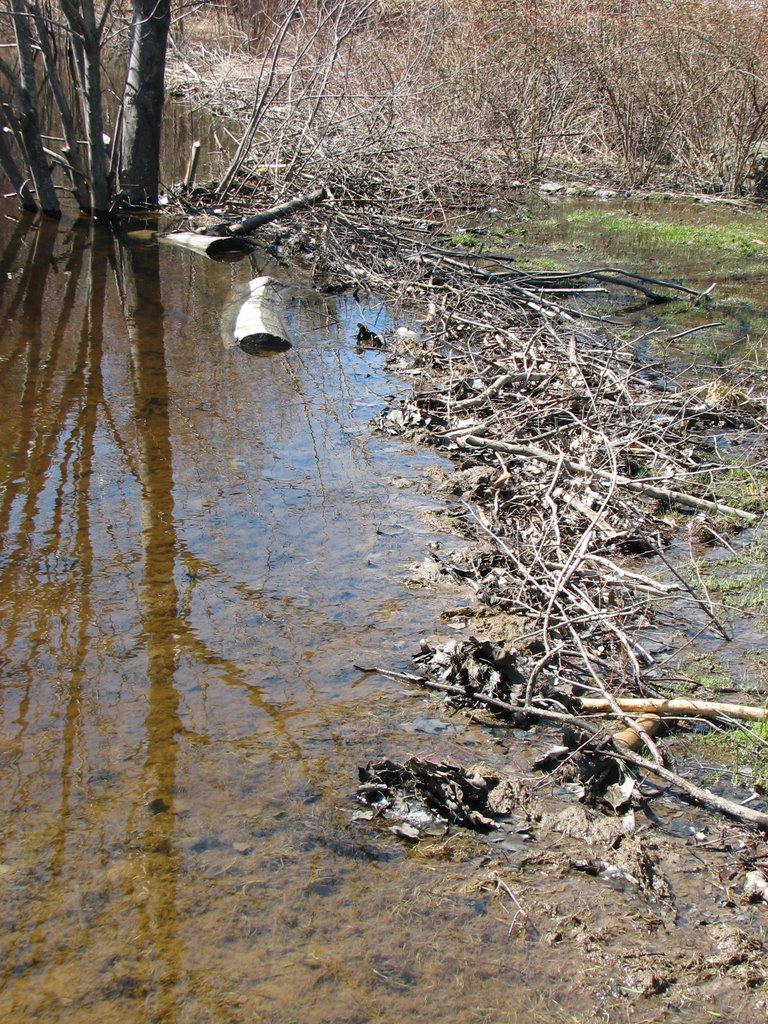
I said I'd post some pictures of the beavers in our pond. Their industry is inspiring. Above, you can see the edge of the dam and how the pond's water level is above the surrounding land. Below, you can see how they've started hauling in big logs to reinforce their mud-and-stick wall. Anything that's not tied down, they cart away and use to shore up the dam: a snow shovel; a whiffle ball bat; an oar from a boat.

This is where they live, the lodge. They recently had young beavers, who, I imagine, will be swimming down stream to build a damn (oops, typo--but I'll leave it, because that's how people feel about it) on my neighbor's property. ("This pond ain't big enuff fer all o' us beavers.")


And here are the wetlands on the other side of our house, a paradise for birders. Muddy Man lived just to the left of this scene.

Inflated Writing

You might not have made it to the end of Kathleen Coleman's 3000 word review of:

Andrew Bell, Spectacular Power in the Greek and Roman City. Oxford/New
York: Oxford University Press, 2004. Pp. viii, 289. ISBN
0-19-924234-8. $125.00.
In which case you would have missed the following paragraphs, which go to show how little, it seems, one may get these days for $125. (And, let's see, an iPod on ebay costs ...?)
Apart from numerous instances of faulty grammar, syntax, and
punctuation, and the recurrent obstacle posed by awkward parentheses,
the book is written in a very obfuscating manner, with a plethora of
abstract nouns (often employed in an otiose plural: "behaviours,"
"circumspections," "hungers," "needinesses," "persuasivenesses",
"rhetorics," etc.; even dignitates) and superfluous adverbs. Two
indications of Bell's failure to achieve clarity of expression are his
use of neologisms (of which "gladiatoriality" is the most egregious)
and his habit of embedding quotations from other scholars within his
sentences, where they often do not fit properly, instead of struggling
to say what he means in his own words; discounting conventional
quotations set off from the syntax of the surrounding discourse, in the
first chapter (23 pages) he embeds 29 such quotations. The second
chapter contains a particularly distracting example of this habit
(45-6): "Analysis of such coherence requires perhaps more emphasis upon
'how the elite were perceived by others' and not so much 'how they
perceived themselves' if one wishes to understand 'that deliberate
balance between individual ambition and common values' which served
'for four centuries to sustain aristocratic ascendancy';" a footnote
adds: "Thus contra Gruen 1996: 225." Bell presumably means that he
considers the e/lite's self-perception in Antiquity more important than
their perception by others, whereas Gruen thinks the opposite
(misquoted, incidentally: he wrote "delicate," not "deliberate"); but
straightforward formulations, alas, are hard to find among these pages.
Furthermore, numerous colloquialisms also smack of failure to think of
the right expression: "sexily charismatic" (37) seems a very unlikely
description of Sulla.

Curiously, the first footnote in the book, appended to the sentence in
which Bell states that Ceaus,escu's speech was delivered on 21 December
1989, claims inter alia that "Much of the following is based upon the
New York Times of 12 and 13 December 1989." Admittedly, since the
subsequent account of Ceaus,escu's fall ranges both backwards from his
catastrophic speech as well as forwards, news reports may have been
filed on those two dates that supplied Bell with some critical
information; but the apparent contradiction is, unfortunately, a
harbinger of much that is muddled or confusing in the book as a whole.
Division between paragraphs frequently seems arbitrary, betrayed by the
use of pronouns whose referent is buried in a previous paragraph; there
are distortions of detail;[[5]] translations from ancient sources are
sometimes so literal as to sound garbled;[[6]] the relevance of some
footnotes is not clear.[[7]] Frequently one suspects that Bell was not
thinking about what he wrote, otherwise how could he claim, for
example, that "the populus Romanus is accorded much greater symbolic
significance than in, say, the Grand Procession of Ptolemy
Philadelphus" (159), or refer to "the living, breathing Roman
constitution" (207)?

5. E.g. (to cite three different categories of distortion) the claim
(49) that Cicero was sufficiently familiar with the Iliad "not to need
to bother" to look up passages he quoted (quotation from memory was the
default position in Antiquity, the process of checking a papyrus roll
being so cumbersome; Gellius himself, whom Bell cites in n. 126, is
surprised not by Cicero's error but by Tiro's failure to correct it);
or the implication (167) that Pompey's theater was grafted onto an
earlier temple of Venus Victrix (the temple-complex, which indeed seems
to have been built upon the site of an earlier temple, itself contained
a shrine to Venus, whose grand stepped approach was a pretext for the
cauea); or a misdirected attempt (174) to register a supplement by
Baiter at Cic. Sest. 106.

6. "The city, cherish, my Caelius, the city and live in its light!"
(18), "he accomplished his plan by great effort and by great dangers"
(40), "he so demagogued the vulgar and the poor" (97), "when his rule
was being snatched away" (144). At Diod. 31. 16. 1 a crucial
ga/r must be translated if the train of thought is to be
clear (140).

7. E.g. 35 n. 59, 56 n. 20, 87 n. 169, 113 n. 299, 117 n. 14, 137 n.
110, 194 n. 180.

09 April 2006

What, Precisely, Is the Matter?

What, if anything, is wrong with the following translations of the highlighted sentences (the first from Ross, the second from Tredennick, the third from Devereux)?

le/gw d' u(/lhn h(\ kaq' au(th\n mh/te ti\ mh/te poso\n mh/te a)/llo mhde\n le/getai oi(=j w(/ristai to\ o)/n. e)/sti ga/r ti kaq' ou(= kathgorei=tai tou/twn e(/kaston, w(=| to\ ei)=nai e(/teron kai\ tw=n kathgoriw=n e(ka/sth| (ta\ me\n ga\r a)/lla th=j ou)si/aj kathgorei=tai, au(/th de\ th=j u(/lhj), w(/ste to\ e)/sxaton kaq' au(to\ ou)/te ti\ ou)/te poso\n ou)/te a)/llo ou)de/n e)stin: ou)de\ dh\ ai( a)pofa/seij, kai\ ga\r au(=tai u(pa/rcousi kata\ sumbebhko/j.

By matter I mean that which in itself is neither a particular thing nor of a certain quantity nor assigned to any other of the categories by which being is determined. For there is something of which each of these is predicated, whose being is different from that of each of the predicates (for the predicates other than substance are predicated of substance, while substance is predicated of matter). Therefore the ultimate substratum is of itself neither a particular thing nor of a particular quantity nor otherwise positively characterized; nor yet is it the negations of these, for negations also will belong to it only by accident. (Ross)

By matter I mean that which in itself is neither a particular thing nor a quantity nor designated by any of the categories which define Being. For there is something of which each of these is predicated, whose being is different from that of each one of the categories; because all other things are predicated of substance, but this is predicated of matter. Thus the ultimate substrate is in itself neither a particular thing nor a quantity nor anything else. Nor indeed is it the negations of these; for the negations too will only apply to it accidentally. (Tredennick)
Matter is that which in itself is neither a particular thing nor a quantity ... for there is something of which each of these is predicated, but whose being is different from the being of any of them; for while the other things are predicated of substances, this is predicated of the matter ... nor is it the negations of these, for these will belong [to it] incidentally. (Devereux)
The passage is, of course, from the famous argument about the underlying subject in Aristotle, Metaphysics Z 3 (1029a20-24). It's a difficult passage, and I can't say that I understand it fully. It occurs just after Aristotle has given a thought experiment, where he asks us to strip away the attributes of a bodily substance, leaving only what is apparently the bare substratum underneath.

He then apparently wishes us to reach a similar result by an argument about predication, contained in the quoted passage. The argument, although controverted and obscure, is apparently something like this: the ultimate underlying subject is distinct from anything which is predicated of it; it, therefore, is not what is predicated of it; and thus the ultimate underlying subject is close to being nothing at all --bare matter or (as he later suggests) pure potentiality. (Aristotle then apparently draws the lesson from this that being an ultimate subject of predication is perhaps a sufficient but not a necessary condition for being counted as a substance.)

The reason I ask about the translation of this passage, is that Dan Devereux makes use of the passage in the paper of his that I mentioned in an earlier post ("The Relationship between Books Zeta and Eta of Aristotle's Metaphysics"). I'll explain in a later post the use that Devereux makes of it. For now, I wish to raise a question simply about the translation--since I suspect that the passage should be translated differently from above, and, if it is, then it can no longer be interpreted in the way that Devereux wishes to understand it.

Let me know what you think--your concerns, reservations, endorsements, if any.