08 April 2006

Criticism of the Redaction Criticism

I described yesterday the hypothesis, in redaction criticism, that parts of Aristotle's Metaphysics H were written before parts of Z, on the grounds that Z 7-9 looks intrusive, and that H 3 refers to the argument contained in Z 8 as something that has been proved elsewhere, whereas Z 15 refers to it as something that has been shown earlier. I said that this was a weak if not completely unpersuasive hypothesis. Here are my reasons.

1. Note that Devereux in his statement of the evidence slightly magnifies it. Z 15 does not say 'it has been shown earlier' (e.g. e)/mprosqen). Rather, the two references are almost the same except that H 3 contains a qualification, or marking, that Z 15 lacks--the phrase 'in other (discussions)' (e)n a)/lloij). What Devereux strictly claims is that originally both Z 15 and H 3 had this qualification, or something like it, but that it was removed from Z 15 in a later editing decision.

2. One might doubt that all the editorial cross-references in the Aristotelian corpus were placed there by Aristotle and thus can reasonably serve as evidence of his editorial decisions. But let us put this difficulty aside.

3. Observe that Devereux's hypothesis is inelegant, because he postulates a redactor (presumably Aristotle) who overlooks things and makes mistakes. On Devereux's hypothesis, after the redactor adds Z 7-9, he removes the qualification from the reference in Z 15, but neglects to do so for the reference in H 3. Devereux writes: "But H was apparently not revised at this time: the summary in H 1 was not expanded to take account of the additional chapters in Z, and the reference in H 3 (1043b16-18) was not changed to 'it was shown earlier' [rather than elsewhere] that forms are neither generated nor produced'". But if the redactor might have made a mistake on the second time through, why not, more simply, say that he made a mistake on the first time through and included an inapt qualification to the reference in H 3 (say, because he had drafted some of that material before including it in H--after all, that reference does occur in a parenthetical passage)?

4. Of course, this is to suppose that the qualification, 'elsewhere' (e)n a)/lloij), is inapt as found in H 3, given Z 8. But why should we think this? First, let's note an ambiguity. The phrase e)n a)/lloij can mean either 'in discussions other than this' or 'in various other places.' Assume that it means the first, as Devereux does. Yet why should we presume that, if H were written after Z, it would be inapt for Aristotle to regard Z as a 'different' discussion from H--especially since H first summarizes Z and then initiates something of a new line of discussion at the beginning of H 2? Here is a comparison. Aristotle uses the phrase 'at the beginning (sc. of our discussion)' (e)n a)rxh=|) in seven back references in Nic. Eth. . Twice it refers back to the beginning of the same book. Twice it refers back to a discussion begun in an earlier book. Once it refers back to a discussion begun in the same book, but not in the beginning of it. And twice it refers back to the beginning of the treatise. Clearly, then, what Aristotle counts as 'the beginning' of his present disussion can vary with his purposes and context (for the obvious reason that his treatises are articulated wholes). Clearly, too, it would be possible for Aristotle to count as 'in the same discussion' anything found in the material between what he counts as 'the beginning' of that discussion and where he is presently. Thus, what one needs to show, as regards the reference in H 3, in order to establish that it is inapt in its present context, is that Aristotle, if he were writing that after Z 1-17 as we have it now, couldn't have regarded the statement in H 3 as occurring in a discussion that was, in some respect or for some purpose, not begun before Z 8. And I doubt very much that this can be shown.

5. In fact, there is good reason to think that the reference in H 3 is appropriate and what we should have expected, even given the discussion in Z 8. At the beginning of H 5, Aristotle writes the following:

e)pei\ d' e)/nia a)/neu gene/sewj kai\ fqora=j e)/sti kai\ ou)k e)/stin, oi(=on ai( stigmai/, ei)/per ei)si/, kai\ o(/lwj ta\ ei)/dh (ou) ga\r to\ leuko\n gi/gnetai a)lla\ to\ cu/lon leuko/n, ei) e)/k tinoj kai\ ti\ pa=n to\ gigno/menon gi/gnetai),

Since some things both are and are not, without being liable to generation and destruction --e.g. points, if they exist at all; and in general the forms and shapes of things (because white does not come to be, but the wood becomes white, since everything which comes into being comes from something and becomes something) (1044b21-24).
Note that this refers to the same doctrine defended in Z 8: that forms, although they come into and go out of existence, neither are generated nor suffer corruption. Yet here Aristotle states not only the doctrine, but also his basic grounds for holding it (which I have highlighted). Now note--and this is the important point--that his grounds are simply the doctrine of change that he develops in Physics I. That is, he thinks that the ungenerability and corruptibility of forms follows directly from his doctrine of change. (And it does, clearly.) In this reference in H 5, there was no need to refer back to Z 8, but Aristotle could simply, in a terse phrase, indicate a doctrine he would have regarded as familiar to all. But if this is how he looked at the matter, then, from the vantage point of H 3 also, he would have regarded this doctrine as shown in a great many places besides Z 8, and it would not have been strange for him to use e)n a)/lloij to signify the well-entrenched character of the doctrine. Arguably, even, it would have been odd for him to refer back to Z 8 in particular, as if that were the only place in which this was shown.

This is why I regard the argument proposed by Devereux as quite weak, if not groundless, and as itself providing no reason for us to regard H as written earlier than Z.

07 April 2006

An Argument in Redaction Criticism

This post concerns not a matter of philosophy, nor even the interpretation of texts, but rather 'redaction criticism', that is, speculation about the order of composition of parts of texts and how these parts were combined together into the whole text that we have today.

My interest is an argument, in the redaction criticism of Aristotle's Metaphysics, which I find in a piece by Daniel Devereux, "The Relations between Books Zeta and Eta of Aristotle's Metaphysics" (OSAP Winter, 2003). The argument is as follows.

In Z 8, Aristotle argues that form, although it begins to exist and ceases to exist, properly speaking neither is generated nor suffers corruption, because the only things that can be generated (or made), and thus which can suffer corruption (or be destroyed), are composites of form-in-matter.

Devereux states:

Scholars have argued...that chapters 7-9 and chapter 12 are 'later insertions' in Z since (i) they are intrusive in their context and (ii) there is no mention of them in the summary at the beginning of H. Further, in H 3 Aristotle says that it was shown elsewhere--not in Z or H--that forms are neither generated nor produced (1043b16-18). But Z 8 contains an argument for this thesis, so it seems that this chapter was not a part of Z when the reference in H 3 was written. These details suggest that there was an early, 'first' version of Z which is summarized at the beginning of H, and a later expanded version containing the 'inserted' chapters, Z 7-9 and Z 12.

Other parts of Z were apparently revised at the time that Z 7-9 were added. In Z 15, for example, Aristotle mentions that it was shown earlier that the form of a composite is neither generated nor produced (1039b26-27). This is clearly a reference to the argument in Z 8, which has now been incorporated into Z. But H was apparently not revised at this time: the summary in H 1 was not expanded to take account of the additional chapters in Z, and the reference in H 3 (1043b16-18) was not changed to 'it was shown earlier' [rather than elsewhere] that forms are neither generated nor produced' . The expanded and revised version of Z which we possess is later than H -- H is contemporary with an earlier, shorter version of Z.
This is an interesting argument. Yet it seems to me weak, and perhaps even without any force. My concern isn't with the disputable assumption that the summarizing paragraph at the beginning of H was meant to be so thorough that, if something is not mentioned in that paragraph, then we may deduce that that was not contained in the version of Z which the paragraph attempts to summarize.

It's rather with the nature of the two apparent back references. I'll paste them here and later share with you my doubts.

The reference in Z 15, 1039b26-27

e)pei\ d' h( ou)si/a e(te/ra, to/ te su/nolon kai\ o( lo/goj (le/gw d' o(/ti h( me\n ou(/twj e)sti\n ou)si/a, su\n th=| u(/lh| suneilhmme/noj o( lo/goj, h( d' o( lo/goj o(/lwj), o(/sai me\n ou)=n ou(/tw le/gontai, tou/twn me\n e)/sti fqora/ (kai\ ga\r ge/nesij), tou= de\ lo/gou ou)k e)/stin ou(/twj w(/ste fqei/resqai (ou)de\ ga\r ge/nesij, ou) ga\r gi/gnetai to\ oi)ki/a| ei)=nai a)lla\ to\ th=|de th=| oi)ki/a|), a)ll' a)/neu gene/sewj kai\ fqora=j ei)si\ kai\ ou)k ei)si/n: de/deiktai ga\r o(/ti ou)dei\j tau=ta genna=| ou)de\ poiei=.

[20] Since substance is of two kinds, the concrete thing and the formula (I mean that one kind of substance is the formula in combination with the matter, and the other is the formula in its full sense), substances in the former sense admit of destruction, for they also admit of generation. But the formula does not admit of destruction in the sense that it is ever being destroyed, since neither does it so admit of generation (for the essence of house is not generated, but only the essence of this house); formulae are , and are not, independently of generation and destruction; for it has been shown that no one either generates or creates them.

The reference in H 3, 1043b16-18

(a)na/gkh dh\ tau/thn h)\ a)i/+dion ei)=nai h)\ fqarth\n a)/neu tou= fqei/resqai kai\ gegone/nai a)/neu tou= gi/gnesqai. de/deiktai de\ kai\ dedh/lwtai e)n a)/lloij o(/ti to\ ei)=doj ou)qei\j poiei= ou)de\ genna=|, a)lla\ poiei=tai to/de, gi/gnetai de\ to\ e)k tou/twn.

Now the substance must be either eternal or perishable without ever being in process of perishing, and generated without ever being in process of generation. It has been clearly demonstrated elsewhere that no one generates or creates the form; it is the individual thing that is created, and the compound that is generated.

06 April 2006

The Parity of the Categories

Yesterday I argued: Aristotle counts words indicating time (pote) as a category; thus time has the same standing as item in any other category. I called this an argument from 'parity'.

This of course raises the question of whether, for Aristotle, there is parity among the categories. And one might argue that clearly there isn't. After all, substance is primary. And then Aristotle standardly gives only four categories when referring to them--substance, quality, quantity, relation--as if to suggest that these are somehow more fundamental. Of these, he seems to regard relation as a low-level sort of existence (Nic. Eth. I.6).

Of course, even if 'time' were somehow ranked lower than other categories, this would no more imply that it is mind-dependent than that 'location' (pou) is, or, indeed, action and passion.

These reflections invite the question, whether there some system in Aristotle's categories. Is his list of ten meant to be exhaustive, or open-ended? If he meant it to be exhaustive, did he implicitly have an argument that it is? In the introduction to his edition of the Metaphysics, Ross gives what is probably the common view:

Aristotle has no 'deduction of the categories', no argument to show that the real must fall into just these divisions. He seems to have arrived at the ten categories by simple inspection of reality, aided by a study of verbal distinctions (lxxxv).
But this seems a non sequitur. What is at issue is not how Aristotle arrived at them, or how he presents them in the Categories, but whether, upon reflection he was willing to stand by them, by giving reasons against alternatives, or for his own list.

Since, it is true, there is no such defense in the Aristotelian corpus, if such a defense were contemplated, we would need to arrive at it by the perfectly respectable enterprise of rational reconstruction.

The best effort along these lines that I have seen may be found in a recent article by Kyle Fraser, "Seriality and Demonstration in Aristotle's Ontology", in OSAP, Winter 2003. Since I am writing a review of this volume, to be published elsewhere, I'll say little more about Fraser's article.

However, I do wish to note here the following. In an Appendix, "On the Neoplatonist 'Deduction' of the Categories", Fraser reproduces a standard neoplatonic systematization of the categories, which Ross gives in his commentary introduction, on page lxxxvi. Fraser also gives Brentano's classification (from On the Several Senses of Being in Aristotle). Yet he does not refer to Aquinas' interesting systematization, in his Metaphysics commentary (lect. 9, n. 892), which I'll therefore paste below. (I copy it from the excellent site, Corpus Thomisticum.)
Sciendum enim est quod praedicatum ad subiectum tripliciter se potest habere. Uno modo cum est id quod est subiectum, ut cum dico, Socrates est animal. Nam Socrates est id quod est animal. Et hoc praedicatum dicitur significare substantiam primam, quae est substantia particularis, de qua omnia praedicantur.

Secundo modo ut praedicatum sumatur secundum quod inest subiecto: quod quidem praedicatum, vel inest ei per se et absolute, ut consequens materiam, et sic est quantitas: vel ut consequens formam, et sic est qualitas: vel inest ei non absolute, sed in respectu ad aliud, et sic est ad aliquid. Tertio modo ut praedicatum sumatur ab eo quod est extra subiectum: et hoc dupliciter. Uno modo ut sit omnino extra subiectum: quod quidem si non sit mensura subiecti, praedicatur per modum habitus, ut cum dicitur, Socrates est calceatus vel vestitus. Si autem sit mensura eius, cum mensura extrinseca sit vel tempus vel locus, sumitur praedicamentum vel ex parte temporis, et sic erit quando: vel ex loco, et sic erit ubi, non considerato ordine partium in loco, quo considerato erit situs. Alio modo ut id a quo sumitur praedicamentum, secundum aliquid sit in subiecto, de quo praedicatur. Et si quidem secundum principium, sic praedicatur ut agere. Nam actionis principium in subiecto est. Si vero secundum terminum, sic praedicabitur ut in pati. Nam passio in subiectum patiens terminatur.

Quia vero quaedam praedicantur, in quibus manifeste non apponitur hoc verbum est, ne credatur quod illae praedicationes non pertineant ad praedicationem entis, ut cum dicitur, homo ambulat, ideo consequenter hoc removet, dicens quod in omnibus huiusmodi praedicationibus significatur aliquid esse. Verbum enim quodlibet resolvitur in hoc verbum est, et participium. Nihil enim differt dicere, homo convalescens est, et homo convalescit, et sic de aliis. Unde patet quod quot modis praedicatio fit, tot modis ens dicitur.

05 April 2006

Striking the Mean--An Anecdote

It's hard sometimes to know when, as a father, one is striking the right balance between sheltering one's children and letting them gain experience of the world. The following story made me think that maybe an adjustment is in order.

Sunday last we were at a friend's house for a party, and my 5-year old, Joseph, was playing with a friend, Andrew, about the same age, who attends a public school in a moderately tough area. Someone overheard this exchange and later told me about it:

Andrew: "I'm going to kick you in the crapper and knock you in the bonkers!"

Joseph: "Oh, yeah? Well I'm going to act like a penguin."
Clearly, not the coolest or toughest kid on the street. The movie he's seen most recently? March of the Penguins--not exactly filled with vicious penguin aggression.

And yet... what he said made just as much sense.

The Inaudible and Noiseless Foot of Time

I mentioned yesterday that there are some passages in Aristotle which seem difficult to reconcile with the thesis that time is in any way mind dependent. In both passages, Aristotle argues that time has no boundary, either a beginning or an end. In both passages, he argues by pointing to the connection between time and change.

These arguments would clearly be unsound, if some other condition besides change were necessary (the existence of a mind) in order for time to exist. Moreover, in both passages Aristotle's mention of time seems gratuituous, in the sense that an appeal to change would seem to be sufficient. But then why would he appeal additionally to something that he regarded as introducing extra assumptions and conditions?

The first passage is from Metaphysics Lambda (ch. 6, 1071b3-11)

Since there were three kinds of substance, two of them physical and one unmovable, regarding the latter we must assert that it is necessary that there should be an eternal unmovable substance. For substances are the first of existing things, and if they are all destructible, all things are destructible. But it is impossible that movement should either have come into being or cease to be (for it must always have existed), or that time should. For there could not be a before and an after if time did not exist (a)ll' a)du&naton ki/nhsin h2 gene/sqai h2 fqarh~nai-a)ei\ ga_r h}n-ou)de\ xro&non. ou) ga_r oi[o&n te to_ pro&teron kai\ u3steron ei]nai mh_ o1ntoj xro&nou). Movement also is continuous, then, in the sense in which time is; for time is either the same thing as movement or an attribute of movement.
This argument denies a beginning of time, arguing from this to the eventual conclusion that an eternal thinking substance exists. But that would be a circular argument, if time presupposed a thinking being.

The second is from the Physics discussion of time itself:
Will time then fail? Surely not, if motion always exists. (a}r' ou}n u(polei/yei; h)\ ou)/, ei)/per ai)ei\ e)/sti ki/nhsij;) Is time then always different or does the same time recur? Clearly time is, in the same way as motion is (dh~lon o3ti w(j a2n h( ki/nhsij, ou3tw kai\ o( xro&noj). For if one and the same motion sometimes recurs, it will be one and the same time, and if not, not (Physics 4.13, 222a29-32).
As regards this passage, there would be an obvious rejoinder to Aristotle's conclusion if time required the existence of a mind that can count: Why should the repetition of the same motion imply the repetition of the same time, if that motion were counted differently in each occurrence (just as we can use the same fingers to count to 20 or 30, as well as to 10)?

Also, it's not clear, even, that the passage in Physics that most suggests the mind-dependence of time isn't dialectical. And the way in which it raises the difficulty is strange. Why develop this in terms of impossibility ("if it is impossible that a counter exists, then it is impossible that anything countable exist")? The very manner in which Aristotle phrases this makes one suspect he regards it as a false argument. (And do we want to say that, for Aristotle, numbers too are mind-dependent?):
Whether if soul did not exist time would exist or not, is a question that may fairly be asked; for if there cannot be some one to count there cannot be anything that can be counted (a)duna&tou ga_r o1ntoj ei]nai tou~ a)riqmh&sontoj a)du&naton kai\ a)riqmhto&n ti ei]nai), so that evidently there cannot be number; for number is either what has been, or what can be, counted. But if nothing but soul, or in soul reason, is qualified to count, there would not be time unless there were soul, but only that of which time is an attribute, that is, if movement can exist without soul, and before and after are attributes of movement, and time is these qua numerable (Physics 4.14, 223a21-28)
Apart from these passages, there is also the consideration that Aristotle lists 'time' as a category (that is, a sort of thing indicated by a sort of predicate). By parity, we should no more expect that time is mind-dependent than what is indicated by any other category.

Let me clarify my concern here. I'm wondering how Coope deals with these passages, since they seem on their face at odds with a main the thesis of the book. And I wish that the reviewer in NDPR had addressed these concerns!

04 April 2006

Time is Always About in the Quad

According to Aristotle, does time depend upon the existence of a mind which perceives (or marks) time? I have not seen the book, but apparently this is what Ursula Coope argues in her recent Time for Aristotle. As the review in NDPR by Andrea Falcon explains:

Aristotle defines time as a kind of number. More precisely, time is "a number of change with respect to the before and after" (219 b 1-2). Coope argues that in defining time as a kind of number Aristotle defines it as something that is essentially countable. On her reading, time gets counted by counting instants of time. Moreover, when we count an instant of time, we mark a potential division in all the changes that are then going on. Counting instants of time turns out to be a way of arranging all the changes that are going on in a single before and after series. ...

A somewhat surprising consequence of Aristotle's definition of time is the claim that time is dependent upon a mind which can count (I should say a soul which can count). For Aristotle the dependence of time upon the mind (the soul) implies that there would be no time without beings that are able to count. But this does not extend to change despite the fact that time and change are intimately connected. Coope focuses on the different way in which time and change relate to the mind (the soul). It follows from the definition of time that time cannot exist in the absence of beings that are able to count because time is defined as something that can be counted. But it does not follow from the definition of change that change depends upon beings that are able to count. Remember that the definition of change is carefully crafted to make no reference, implicit or explicit, to time. In other words, time is essentially countable, whereas change is not. But this is consistent with the claim that there is no change without time and there is no time without change.
I don't know which of the following is Coope's thesis (or perhaps it is some other claim):
(i) For time always to exist, at least one mind must at some time exist;
(ii) Time exists only so long as at least one mind exists that is capable of marking it; or
(iii) Time exists only so long as it is actually being marked (or perceived) by a mind.
(i) seems strange, inelegant, and possibly circular. (ii) also seems strange (and possibly circular as well): why should time exist when it is not marked, just because something exists which can mark it? (If that were so, then wouldn't it exist also if only it were possible that something existed which could mark it?) And yet, on (iii), time would be going in and out of existence, depending upon its being marked or not.

One thinks of sensibles, in response, and yet these admit of a teleological explanation. Do we want to say that time is for the sake of something?

Apart from all this, aren't there texts in Aristotle, referring to time, which can hardly be interpreted to mean that time depends on a mind? I wonder how Coope deals with these. I'll post them tomorrow.

Matrix=Cave?

I'm looking forward to this lecture.

On whether it is another worthy footnote to Plato, see John Partridge's contribution to a fascinating web collection of essays on the film.

Iakovos Vasiliou, another ancient philosopher, also contributes an essay.

"The Matrix as Metaphysics" by David Chalmers

Tuesday, April 18, 2006 at 4:00 p.m.
Lurie Conference Room,
Higgins University Center, Clark University

Are we living in a Matrix? And if so, is our perception of the external world illusory? Many people, including philosophers from Descartes to Morpheus, say yes: if we're in a Matrix, then the ordinary objects that we seem to see don't exist, and we're radically deluded. I say no: even if we're in a Matrix, ordinary objects still exist, and most of our beliefs about the external world are correct. Instead, we can see the Matrix hypothesis as a metaphysical hypothesis about the underlying nature of our world.

Chalmers is Professor of Philosophy and Director of the Centre for Consciousness at the
Australian National University.

Aristotle Against the Libertarians

Serena Olsaretti's critique of libertarianism, at least as reported in Iwao Hirose's review, seems to be the result of two applications of Aristotelian ideas.

The first Aristotelian idea is that our conferring or accepting something voluntarily cannot constitute an injustice against us (see Nic. Eth. 5.9, 11). The second is that a sort of action that we do only as the lesser of two evils (a 'mixed action', Nic. Eth. 3.1) is not voluntary--or, at least, it is not a standard case of a voluntary action.

Olsaretti apparently uses the first idea in a reconstruction of Nozick's famous argument, that states of affairs that are the consequence of free market choices are just. Olsaretti argues, in effect, that the appropriate standard is not that such actions are free, but rather that they are voluntary--relying, apparently, on the intuition that one cannot voluntarily be treated unjustly.

She then points out that many market transactions that might be considered 'free', in Nozick's sense (that is, not violating any right), are nonetheless not voluntary, because they are done only because there is no 'acceptable' alternative. Here is Hirose's account of the crucial argument:

According to libertarians such as Robert Nozick, a distributional inequality is just when and because it has been brought about as a result of the voluntary and free exchange of legitimately acquired resources between self-owning persons. Individuals have full ownership rights in themselves and external resources, and what justice requires is the voluntary and free consent of these individuals. Libertarians claim that a free market society is a society where nearly all interferences with people are voluntarily consented to, so there is nearly no limitation of people's freedom. Individuals have certain rights, and voluntariness is a necessary and sufficient condition for the legitimacy of nearly all interferences with people. Market is said to satisfy this voluntariness requirement. It appears clear that freedom and voluntariness play crucial role in the libertarian defence of the free market.

Then, Olsaretti reconstructs the libertarian argument using two important notions: the rights-defined freedom and the rights-defined voluntariness. According to the rights-defined freedom, an individual's freedom is curtailed only when he is prevented from doing what he has a right to do. This characterization of freedom is quite familiar from the work of Nozick and the recent literature on the individual rights and freedom in social choice theory. Olsaretti offers her own characterization of voluntariness, which is less familiar to us. "An action or a choice is non-voluntary, or forced, I suggest, if and only if it is done because there is no acceptable alternative to it, where the standard of acceptability is an objective one" (p. 119). Nozick seems to derive his right-definition of voluntariness from his rights-definition of freedom, and does not distinguish voluntariness and freedom in the way Olsaretti suggests. But, given the proper distinction between these two notions, she argues, Nozick's notion of voluntariness rests on a mistake. For example, consider the case of worker W and employer E, where W offers a poorly paid hazardous job to E who would be unemployed and eventually starve if he does not work for E. If we assume that the right-defined voluntariness presupposes the rights-definition of freedom (i.e. voluntariness is derived from freedom), then we must agree with the following step of reasoning.

  1. If E acts within his rights, he does not infringe W's rights;
  2. If W's rights are not infringed by E's actions, then E's affecting of W does not render unfree;
  3. If W is not rendered unfree, then W acts voluntarily; therefore,
  4. W does not act non-voluntarily if E, by limiting W's choice, has acted within his rights.

Olsaretti claims that (3) is false. This is because W has no alternative other than working for E! W does not voluntarily choose to work for E, even though he is not rendered unfree. The decision to take part of market transactions hardly counts as a voluntary choice. The upshot is that morally defined freedom does not guarantee voluntariness, and hence that freedom and voluntariness are quite distinct notions. Olsaretti's proposed notion of voluntariness now appears to be more plausible than Nozick's. She further contends that even if a rights-respecting free market were a realm in which people's freedom is not curtailed and transactions are not coercive, it does not follow that it would host only voluntary transactions. As the libertarian defense of the free market relies on an incorrect understanding of the relationship between freedom and voluntariness, it does not establish the claim that market-created inequality is just. It should be noted that Olsaretti picks out the internal incoherence in the libertarian defence of the free market by appealing to the notions of freedom and voluntariness, which libertarians heavily rely on but fail to distinguish properly. She does not appeal to any consideration external to libertarianism. This makes Olsaretti's criticism powerful and distinctive.

This raises interesting questions from an Aristotelian point of view. For instance, can we make a distinction, as Aristotle does as regards 'mixed actions', and say that, although W's working for E is not something that W would choose considered on its own, still, in the circumstances, it is something that W does voluntarily (just as the captain of the ship voluntarily jettisons the cargo in a storm)? But, if so, should we say that the arrangement is an injustice only 'in the abstract' yet just in these particular circumstances? Or should we simply say that the arrangement is not wrong because it is unjust, but wrong because contrary to some other virtue?

03 April 2006

An Aristotelian Protrepticus in a Connecticut Yankee's Hall

Very much worth knowing about, a workshop by Doug Hutchinson and Monte Johnson at Yale:

Thursday, 6 April
4-6 pm Session 1:
ARISTOTLE'S PROTREPTICUS: TEXT AND CONTEXT
Location: Connecticut Hall, room 104


Friday, 7 April
2-4 pm Session 2:
ARISTOTLE'S PROTREPTICUS, CHAPTER 10:
PHILOSOPHY OF POLITICAL SCIENCE
Location: LC room 205

Saturday, 8 April
10am-noon Session 3:
NEW PAPYRUS FRAGMENTS OF ARISTOTLE'S PROTREPTICUS
Location: Connecticut Hall, room 104
lunch provided for all (!)

1:30-3pm Open discussion session

Arabic Papyrology Database

Through friends I learned of a new Arabic Papyrology Database :

The Arabic Papyrology Database allows you to search Arabic documents on
papyrus, parchment and paper from the 7th up the 16th century A.D. -
the first 163 (out of ca. 2,000) are now at your disposal. Use this
database to locate relevant historical data, investigate linguistic
peculiarities, find references and more.

The Ousia of the Soul

The claim is that, according to Phaedo 92d, Plato is thinking of the soul as having within it some sort of 'being' (ousia) which is such that, (i) to affirm the independent existence of the Forms, regarding this 'being' as derived from them, and (ii) to affirm the existence of the soul before its entering the body, amount to the same thing.

Here are two passages which support this interpretation, both of which are plausibly taken as antecedent referents.

In the first, 75d, Socrates compares our applying the label 'what is' to the Forms, to our placing a seal or guarantee of authenticity upon them. This suggests that 'what is' is applied to the Forms as to something primary; that it is not applied to them derivatively. (There is no suggestion in the Phaedo that there is a primary form of Existence Itself from which other Forms besides that derive their existence. The dialogue seems to recognize no hierarchy in the Forms.) If so, then the ousia in 92d, to which the term 'what is' is said to apply derivatively, should not be understood as the ousia of the Forms.

“Now if we had acquired that knowledge before we were born, and were born with it, we knew before we were born and at the moment of birth not only the equal and the greater and the less, but all such abstractions? For our present argument is no more concerned with the equal than with absolute beauty and the absolute good and the just and the holy, and, in short, [75d] with all those things which we stamp with the seal of absolute in our dialectic process of questions and answers; so that we must necessarily have acquired knowledge of all these before our birth.”

ou)kou=n ei) me\n labo/ntej au)th\n pro\ tou= gene/sqai e)/xontej e)geno/meqa, h)pista/meqa kai\ pri\n gene/sqai kai\ eu)qu\j geno/menoi ou) mo/non to\ i)/son kai\ to\ mei=zon kai\ to\ e)/latton a)lla\ kai\ su/mpanta ta\ toiau=ta; ou) ga\r peri\ tou= i)/sou nu=n o( lo/goj h(mi=n ma=llo/n ti h)\ kai\ peri\ au)tou= tou= kalou= kai\ au)tou= tou= a)gaqou= kai\ dikai/ou kai\ o(si/ou kai/, o(/per le/gw, peri\ a(pa/ntwn oi(=j e)pisfragizo/meqa to\ au)to\ o(\ e)/sti kai\ e)n tai=j e)rwth/sesin e)rwtw=ntej kai\ e)n tai=j a)pokri/sesin a)pokrino/menoi. w(/ste a)nagkai=on h(mi=n tou/twn pa/ntwn ta\j e)pisth/maj pro\ tou= gene/sqai ei)lhfe/nai.

In the second, 76e, Socrates actually identifies the ousia of the Forms with something in the soul:

“Then, Simmias” said he, “is this the state of the case? If, as we are always saying, the beautiful exists, and the good, and every essence of that kind, and if we refer all our sensations to these, [76e] which we find existed previously and are now ours, and compare our sensations with these, is it not a necessary inference that just as these abstractions exist, so our souls existed before we were born; and if these abstractions do not exist, our argument is of no force? Is this the case, and is it equally certain that provided these things exist our souls also existed before we were born, and that if these do not exist, neither did our souls?”

a)=r' ou)=n ou(/twj e)/xei, e)/fh, h(mi=n, w)= Simmi/a; ei) me\n e)/stin a(\ qrulou=men a)ei/, kalo/n te/ ti kai\ a)gaqo\n kai\ pa=sa h( toiau/th ou)si/a, kai\ e)pi\ tau/thn ta\ e)k tw=n ai)sqh/sewn pa/nta a)nafe/romen, u(pa/rxousan pro/teron a)neuri/skontej h(mete/ran ou)=san, kai\ tau=ta e)kei/nh| a)peika/zomen, a)nagkai=on, ou(/twj w(/sper kai\ tau=ta e)/stin, ou(/twj kai\ th\n h(mete/ran yuxh\n ei)=nai kai\ pri\n gegone/nai h(ma=j: ei) de\ mh\ e)/sti tau=ta, a)/llwj a)\n o( lo/goj ou(=toj ei)rhme/noj ei)/h; a)=r' ou(/twj e)/xei, kai\ i)/sh a)na/gkh tau=ta/ te ei)=nai kai\ ta\j h(mete/raj yuxa\j pri\n kai\ h(ma=j gegone/nai, kai\ ei) mh\ tau=ta, ou)de\ ta/de;

Rowe remarks on this second passage: "What 'was there before' (u(pa/rxousan pro/teron), is 'rediscovered' (a)neuri/skontej), and 'is ours' (h(mete/ran ou)=san), is clearly not the ou)si/a in question, as the text literally says, but our knowledge of it." But if knowledge of a Form amounts to contact, presence, or reception, as Socrates variously says, then the difference between our knowledge of the Forms, and the Forms themselves, is unimportant and makes this manner of speech understandable.

01 April 2006

Invasion of the Pigs


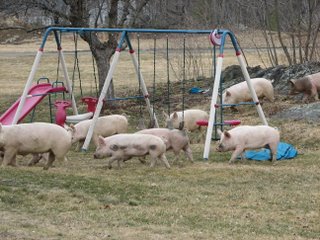
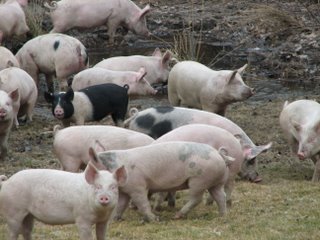
Hey, why not? -- Here are pictures of the 80+ pigs, escapees from Manny's Dairy Farm down the road, that invaded our yard on March 12. Not something you see every day. So why not post them? I'll try to post a picture of the beavers in our pond, and the Blue Heron, too, when it shows up.

Mirror of the Forms

I earlier asked about the meaning of the following sentence in the Phaedo:

e)rrh/qh ga/r pou ou(/twj h(mw=n ei)=nai h( yuxh\ kai\ pri\n ei)j sw=ma a)fike/sqai, w(/sper au)th=j e)stin h( ou)si/a e)/xousa th\n e)pwnumi/an th\n tou= o(\ e)/stin

Here is how I think it should be understood:
For the soul of a human being (h(mw=n) was said, I take it, to exist even before it enters the body. This was said on the same grounds as that (ou(/twj ... w(/sper...) in the soul (au)th=j) there exists that sort of existence (e)stin h( ou)si/a) which has a derivative name (e)/xousa th\n e)pwnumi/an) that is derived from (th\n tou= ) that which is.
Remarks:
  1. 'soul of a human being ...enters the body': 'human being' for h(mw=n, since the quoted expression seems to stand proxy here for ones that Plato uses elsewhere, when he speaks of the soul 'being in the form of a human being' (en anthrwpou eidei, 76c8) or 'entering a human sort of body' (eis anthrwpeion swma aphikesthai, 77b8).
  2. 'This was said on the same grounds as': because what follows involves no reported speech. Apparently Simmias now wants to affirm for his own part the relevant grounds for the earlier conclusion that he reports.
  3. 'in the soul': literally, the ou)si/a belongs to the soul; but this is the more natural way of putting it--the ou)si/a is within the soul as belonging to it. (This is not 'impossibly harsh' because it seems that Plato wishes to construct a parallel in syntax, which serves to highlight the parallelism of philosophical grounds: h(mw=n ei)=nai h( yuxh\ ... au)th=j e)stin h( ou)si/a...)
  4. 'that sort of existence': ou)si/a is used earlier in the dialogue for a sort or class of existing things (and see 76c9 for 'that sort of ou)si/a').
  5. 'that which is': Rowe is probably correct that this is a schematic expression. Unpacked, what I think it suggests is that, for each Form, there is something in the soul which exists and derives its name from it.
  6. 'a derivative name': this would not exclude many things' in the soul having such derivative names, cf. the singular used for two opposites at 103b8.

I'll say tomorrow why I think that this is important for our understanding of the Recollection Argument. But here is a brief indication.

In the Recollection Argument, Socrates has his interlocutors agree on two occasions that the following claims stand and fall together: (i) the Forms exist; (ii) the soul pre-exists the body. This puzzles commentators, because they take standing and falling together to be the same as logical equivalence (co-implication), yet, although Socrates gives an argument from (i) to (ii), he doesn't give an argument from (ii) to (i). (Nor does it seem that such an argument is possible.)

The sentence translated above is clearly meant to refer back to that earlier agreement (although it reflects also, surely, Simmias' appreciation of the likeness of the soul to the Forms, which was emphasized in the intervening Affinity Argument). But if it does so refer back, then, it becomes clear that Plato understands the core idea of the Recollection Argument to be something like this: that there are things in the soul (innate ideas, if you will) which admit of being interpreted as imprints of the Forms (and in doing so we regard our names for them to be names derived from the Forms), but to interpret them thus, and to say that the soul pre-exists the body, is to affirm one and the same thing.

It's not that (i) and (ii) imply each other, but that these are two aspects of interpreting the same thing in a certain way.

Things We Must Do

Since a blog perforce has the character of a confession, here's something I confess.

I was unable to post for the last couple of days because my free time was taken up with---brace yourself--The DaVinci Code. The Boston Archdiocese asked me to tape some television spots on the book, to be broadcast at the time of the movie's release. Thus I actually had to read the book and do some research into those misrepresentations which I didn't already know about (e.g. it turns out that there are 673 panes of glass in the Louvre pyramid, not 666; etc.).

Another person involved with me in taping these spots said that she thought the proper attitude to take toward the book was one of derision and dismissiveness. Of course I have had a high-minded contempt for the book: that's why I hadn't spent a moment on it beforehand. Yet this seems to me not an effective approach to take, if one is to dealing with people generally, since most people who have read the book like it very much; they admire the author; and they've been flattered into thinking that they've learned lots of things by reading it. Brown has won their goodwill already; one won't gain it, then, by attacks which imply criticisms of them.

It seems to me, therefore, that although the gross mistakes of the book need to be pointed out, of course, one needs to consider also why people have been so attracted to it. And I think the reason has to do, ultimately, with a failure of our schools and colleges to convey 'Western civilization'--the true history, traditions, art and architecture of which contain more than enough wonders and 'symbols' to gratify common curiosity.

29 March 2006

Recollection and the Soul as Harmony

Here is a point of translation that puzzles me. I wonder what readers think. It is a sentence that occurs in the Phaedo, in Socrates' reply to Simmias, just after Socrates offered the refutation that, if Learning is Recollection, then the soul existed before the parts of the body, and thus it cannot be a harmonia in Simmias' sense at least (that is, one that depends on the parts of which it is a harmonia).

Socrates presents Simmias with a choice: either reject the thesis that Learning is Recollection, or reject the view that the soul is a harmonia of parts of the body. "Now which do you prefer," Socrates asks, "that knowledge is recollection or that the soul is a harmony?" To which Simmias responds:

The former, decidedly, Socrates. For this other came to me without demonstration; it merely seemed probable [92d] and attractive, which is the reason why many men hold it. I am conscious that those arguments which base their demonstrations on mere probability are deceptive, and if we are not on our guard against them they deceive us greatly, in geometry and in all other things. But the theory of recollection and knowledge has been established by a sound course of argument. For we agreed that our soul before it entered into the body existed just as the very essence which is called the absolute exists. [92e] Now I am persuaded that I have accepted this essence on sufficient and right grounds. I cannot therefore accept from myself or anyone else the statement that the soul is a harmony.
I am interested in the highlighted sentence. The Greek is:

e)rrh/qh ga/r pou ou(/twj h(mw=n ei)=nai h( yuxh\ kai\ pri\n ei)j sw=ma a)fike/sqai, w(/sper au)th=j e)stin h( ou)si/a e)/xousa th\n e)pwnumi/an th\n tou= o(\ e)/stin

Above is the Loeb translation of Fowler. Here are some others:
Because it was, of course, asserted that our soul existed even before it entered the body, just as surely as its object exists--the reality which bears the name of "that which is". (Gallop)

...for our soul was said to exist also before it came into the body, just as the reality does that is of the kind that we qualify by the words "which truly is"... (Grube)
Rowe comments and gives a translation:
d8 au)th/ seems a necessary replacement for the far better attested au)th=j. Tr. '[as] the being (h( ou)si/a, as at 76d8-9, of a collection of existents) itself (au)th/) exists, bearing the name of "what is [F]"'. For this interpretation of o(\ e)/stin, see 75d2-3n. The reading au)th=j, 'belonging to it' (in the sense of being the object of the soul's understanding: see Loriaux I 155), although literally in accord with 76e1-2 (tau/thn th/n ou)si/an) u(pa/rxouan ... h(mete/ran ou)=san , and accepted by most recent editors, is impossibly harsh.
Yet it seems to me that Rowe, and all the translators above, go astray in not taking into account, or rendering properly, th\n e)pwnumi/an. This term, it seems, is a technical term elsewhere in the Phaedo, and what it means, in all of its occurrences, is something's deriving its name from something else, which is more properly called by that name. (Below, I paste the relevant passages from a TLG search.) Anything called 'F' is called that derivatively from the Form, F Itself, which is most properly called by that name, 102b2. (This, indeed, seems a consequence of the 'simple' explanation that Socrates advances, that 'a beautiful thing is beautiful because of the beautiful'.) Simmias himself is called 'large' or 'small' by a derived name (eponymia), because of large or small in him (more properly called that), 102c10. Likewise, something that has an opposite is called by that name derivatively, whereas the opposite which it has is more properly called that (103b7-8).

If this is so, then th\n e)pwnumi/an th\n tou= o(\ e)/stin” must mean something like "the name derived from that which is", and it cannot be a reference to the Forms, as the translations above understand it. The phrase apparently refers to something in the soul and should indeed be placed in correspondence with 76e1-2.

What the sentence might mean, I'll try to say tomorrow (or perhaps Friday). It has interesting implications, too, for how the Recollection Argument should be understood.

2. Plato Phil., Phaedo. {0059.004} Stephanus page 102 section b line 2. (Browse)

(b.) kai\ w(mologei=to ei]nai/ ti e3kaston tw~n ei0dw~n kai\ tou&twn

ta}lla metalamba&nonta au)tw~n tou&twn th_n e0pwnumi/an i1sxein,

to_ dh_ meta_ tau~ta h)rw&ta, Ei0 dh&, h} d' o3j, tau~ta ou3twj le/geij,

3. Plato Phil., Phaedo. {0059.004} Stephanus page 102 section c line 10. (Browse)

1Esti tau~ta.

Ou3twj a1ra o( Simmi/aj e0pwnumi/an e1xei smikro&j te kai\ (10)

me/gaj ei]nai, e0n me/sw| w2n a)mfote/rwn, tou~ me\n tw|~ mege/qei

4. Plato Phil., Phaedo. {0059.004} Stephanus page 103 section b line 7. (Browse)

to&te me\n ga&r, w} fi/le, peri\ tw~n e0xo&ntwn ta_ e0nanti/a e0le/go-

men, e0ponoma&zontej au)ta_ th|~ e0kei/nwn e0pwnumi/a|, nu~n de\ peri\

e0kei/nwn au)tw~n w{n e0no&ntwn e1xei th_n e0pwnumi/an ta_ o)nomazo&-

5. Plato Phil., Phaedo. {0059.004} Stephanus page 103 section b line 8. (Browse)

men, e0ponoma&zontej au)ta_ th|~ e0kei/nwn e0pwnumi/a|, nu~n de\ peri\

e0kei/nwn au)tw~n w{n e0no&ntwn e1xei th_n e0pwnumi/an ta_ o)nomazo&-

(c.) mena: au)ta_ d' e0kei=na ou)k a1n pote/ famen e0qelh~sai ge/nesin

27 March 2006

The Definition of Nature in Aristotle, Physics II.1

I don't know how interesting this will be to others, but I found it surprising. (Also, I don't have any commentaries with me, so this definitely counts as seat-of-the-pants scholarship. But that's how all true scholarship starts, isn't it?)

I had always taken it for granted that, at the beginning of Physics II.1, Aristotle presents a definition of 'nature'. But yesterday I began to suspect that he is defining at least three distinct things, and maybe four:

  • nature (phusis)
  • to come to be by nature (phusei)
  • to happen in accordance (or as a result of) a nature (kata phusin)
  • (perhaps) to have a nature (phusin echein)
If this is true, it would be important to distinguish these, and to understand their relation to one another, because so often for Aristotle everything hinges on which notion is taken to be primary and which derivative.

I came suspect this following the maxim (which I stress to my students) that Aristotle should be read backwards. At 193a2 he says, ti/ me\n ou}n e0stin h( fu&sij, ei1rhtai, kai\ ti/ to_ fu&sei kai\ kata_ fu&sin. And then this can be matched fairly well to the text. In what follows I include serially all the lines of the opening of Physics II.1, but I divide them into sections as I think is appropriate.

fu&sij
(Note that, if this parsing is correct, then, in defining phusis, what Aristotle is really wishing to define is a particular manner of constitution, and when he defines phusei, below, what interests him is how something with that sort of constitution perpetuates itself by bringing about things that are like it.)
Tw~n o1ntwn ta_ me/n e0sti fu&sei, ta_ de\ di' a1llaj ai0- (8)
ti/aj, fu&sei me\n ta& te zw|~a kai\ ta_ me/rh au)tw~n kai\ ta_
futa_ kai\ ta_ a(pla~ tw~n swma&twn, oi[on gh~ kai\ pu~r kai\ (10)
a)h_r kai\ u3dwr (tau~ta ga_r ei]nai kai\ ta_ toiau~ta fu&sei
fame/n), pa&nta de\ tau~ta fai/netai diafe/ronta pro_j ta_
mh_ fu&sei sunestw~ta. tou&twn me\n ga_r e3kaston e0n e9autw|~
a)rxh_n e1xei kinh&sewj kai\ sta&sewj, ta_ me\n kata_ to&pon,
ta_ de\ kat' au1chsin kai\ fqi/sin, ta_ de\ kat' a)lloi/wsin: (15)
kli/nh de\ kai\ i9ma&tion, kai\ ei1 ti toiou~ton a1llo ge/noj
e0sti/n, h|{ me\n tetu&xhke th~j kathgori/aj e9ka&sthj kai\
kaq' o3son e0sti\n a)po_ te/xnhj, ou)demi/an o(rmh_n e1xei meta-
bolh~j e1mfuton, h|{ de\ sumbe/bhken au)toi=j ei]nai liqi/noij h2
ghi5noij h2 miktoi=j e0k tou&twn, e1xei, kai\ kata_ tosou~ton, w(j
ou1shj th~j fu&sewj a)rxh~j tino_j kai\ ai0ti/aj tou~ kinei=sqai kai\
(20)
h)remei=n e0n w|{ u(pa&rxei prw&twj kaq' au(to_ kai\ mh_ kata_ sumbebhko/j

fu&sei
(I include in this section the end of the clause of the previous one, highlighted. I believe that these are linked by a phenomenon in Aristotle that I like to call 'chaining', that is, where Aristotle uses the conclusion of one line of thought to begin a seamless transition into another line of thought. The comparison with the physician is sometimes taken to be offered as an illustration of what it is for something to have a nature; I take it to have a more limited purpose, viz. to clarify how something that has a nature perpetuates itself, by causing something similar to exist.)
e0n w|{ u(pa&rxei prw&twj kaq' au(to_ kai\ mh_ kata_
sumbebhko&j (le/gw de\ to_ mh_ kata_ sumbebhko&j, o3ti ge/-
noit' a2n au)to_j au(tw|~ tij ai1tioj u(giei/aj w2n i0atro&j: a)ll'

o3mwj ou) kaqo_ u(gia&zetai th_n i0atrikh_n e1xei, a)lla_ sumbe/- (25)
bhken to_n au)to_n i0atro_n ei]nai kai\ u(giazo&menon: dio_ kai\ xwri/-
zetai/ pot' a)p' a)llh&lwn). o(moi/wj de\ kai\ tw~n a1llwn e3ka-
ston tw~n poioume/nwn: ou)de\n ga_r au)tw~n e1xei th_n a)rxh_n e0n e9au-
tw|~ th~j poih&sewj, a)lla_ ta_ me\n e0n a1lloij kai\ e1cwqen, oi[on
oi0ki/a kai\ tw~n a1llwn tw~n xeirokmh&twn e3kaston, ta_ d' e0n (30)
au(toi=j me\n a)ll' ou) kaq' au(ta&, o3sa kata_ sumbebhko_j
ai1
tia ge/noit' a)\n au(toi=j.

fu/sin e/)xein
(This notion is not mentioned in the summary at 193b2, yet it seems to get distinct treatment. It is a new notion, once hupokeimenon and ousia are introduced, because then the phusis becomes something which something else has.)
fu&sij me\n ou}n e0sti\ to_ r(hqe/n: fu&sin de\
e1xei o3sa toiau&thn e1xei a)rxh&n. kai\ e1stin pa&nta tau~ta ou)si/a:
u(pokei/menon ga&r ti, kai\ e0n u(pokeime/nw| e0sti\n h( fu&sij a)ei/.

kata_ fu&sin
kata_ fu&sin de\ tau~ta& te kai\ o3sa tou&toij u(pa&rxei kaq' (35)
au(ta&, oi[on tw|~ puri\ fe/resqai a1nw: tou~to ga_r fu&sij me\n ou)k
e1stin ou)d' e1xei fu&sin, fu&sei de\ kai\ kata_ fu&sin e0sti/n. ti/ me\n
ou}n e0stin h( fu&sij, ei1rhtai, kai\ ti/ to_ fu&sei kai\ kata_ fu&sin
(I understand the highlighted kai/ to be exepegtical, sc. " 'by nature', in the sense of 'in accordance with nature'".)

25 March 2006

What Should a Review Accomplish?

I was dissatisfied by the recent review in NPDR by Gretchen Reydam-Schils, of Tad Brennan's book, The Stoic Life. It told me almost nothing about the book. I find myself thinking back to the review, trying to reconstruct what I know about the book as based on the review, and I come up with the following:

  • The book contains both introductory and non-introductory material.
  • The introductory passages contain simplifications.
  • It is written in the style of analytic philosophy.
  • Its bibliography largely consists of works written in English.
  • To analyze Stoic arguments, Brennan makes disputable decisions about how to interpret some of their claims.
  • At one point, Brennan appears to misconstrue Pierre Hadot.
  • A reader of this book should not rely upon it alone but should consult primary sources as well.
And somehow the review is written in a tone of disapproval throughout--as if we just know that the book isn't that good, for all of the reasons mentioned.

To me it seemed that the book irked Reydam-Schils for reasons that are ultimately subjective. She should have vented her irritation in a draft, thrown that away, and then written something that was serviceable to others.

24 March 2006

Can Anyone Translate?

I found the following paragraph in this morning's WSJ. It contains sentences written in an obscure language. Can anyone translate?

The belief in the allegedly "Western" nature of democracy is often linked to the early practice of voting and elections in Greece, especially in Athens. Democracy involves more than balloting, but even in the history of voting there would be a classificatory arbitrariness in defining civilization in largely racial terms. In this way of looking at civilizational categories, no great difficulty is seen in considering the descendents of, say, Goths and Visigoths as proper inheritors of the Greek tradition ("they are all Europeans," we are told). But there is reluctance in taking note of the Greek intellectual links with other civilizations to the east or south of Greece, despite the greater interest that the Greeks themselves showed in talking to Iranians, or Indians, or Egyptians (rather than in chatting up the Ostrogoths).
I wonder if the Journal editors left that alone--when it desperately needs editing--because it was written by a Nobel laureate, Amartya Sen.

The op-ed argues, surely rightly, that we shouldn't regard democracy as being linked to racial groups; also, that nearly all peoples and cultures have, or have had, democratic traditions and practices, on which they could draw in order to develop a democratic political society.

But in the quoted paragraph, Sen seems to be claiming: Athens was not distinctive for its democracy, but only for its practices of voting; that the 'Greeks' wanted to forge reciprocal 'intellectual links' with Egyptian, Iranian, and Indian civilizations; also, that the Greeks, for their part, regarded political differences as being unrelated to 'racial' differences.

(And isn't 'chatting up', in British English, an idiom used for a man trying to charm or seduce a woman?)

21 March 2006

"A Grouping of Units"

That's a curious definition of number which Aristotle refers to as being held 'by some' when, in Metaphysics Z.13, he wishes to criticize the view that a substance could be compounded out of other actual substances.

If the substances that supposedly constitute a substance were fully actual, then, Aristotle remarks, what Democritus had claimed would be correct: you couldn't get a single thing out of two, or two things coming from one. (Two would remain two; and the putative 'one' thing would have had to be two from the start.) But the same would hold of any number (not simply two), because a number of things would, on this view, be no more than a 'grouping of units', as indeed some have alleged:

A substance cannot consist of substances present in it in complete reality; for things that are thus in complete reality two are never in complete reality one, though if they are potentially two, they can be one (e.g. the double line consists of two halves-potentially; for the complete realization of the halves divides them from one another); therefore if the substance is one, it will not consist of substances present in it and present in this way, which Democritus describes rightly; he says one thing cannot be made out of two nor two out of one; for he identifies substances with his indivisible magnitudes. It is clear therefore that the same will hold good of number, if number is a synthesis of units, as is said by some; for two is either not one, or there is no unit present in it in complete reality.

a)du/naton ga\r ou)si/an e)c ou)siw=n ei)=nai e)nuparxousw=n w(j e)ntelexei/a|: ta\ ga\r du/o ou(/twj e)ntelexei/a| ou)de/pote e(\n e)ntelexei/a|, a)ll' e)a\n duna/mei du/o h)=|, e)/stai e(/n (oi(=on h( diplasi/a e)k du/o h(mi/sewn duna/mei ge: h( ga\r e)ntele/xeia xwri/zei), w(/st' ei) h( ou)si/a e(/n, ou)k e)/stai e)c ou)siw=n e)nuparxousw=n kai\ kata\ tou=ton to\n tro/pon, o(\n le/gei Dhmo/kritoj o)rqw=j: a)du/naton ga\r ei)=nai/ fhsin e)k du/o e(\n h)\ e)c e(no\j du/o gene/sqai: ta\ ga\r mege/qh ta\ a)/toma ta\j ou)si/aj poiei=. o(moi/wj toi/nun dh=lon o(/ti kai\ e)p' a)riqmou= e(/cei, ei)/per e)sti\n o( a)riqmo\j su/nqesij mona/dwn, w(/sper le/getai u(po/ tinwn: h)\ ga\r ou)x e(\n h( dua\j h)\ ou)k e)/sti mona\j e)n au)th=| e)ntelexei/a|.

What is the source of this curious definition of number? Ross notes the attribution of a very similar formula to Thales:
This is practically the same as the earliest recorded Greek definition of number, mona/dwn su/sthma, which Thales is said to have borrowed from the Egyptians (Iambl. in Nicom. Ar. Introd. p. 10.8). Cf. D.1o20a13n.
I gather that this attribution is not taken to have much weight. At least, "a number is a grouping of units" isn't included in the standard lists of the three things Thales is credited with having said.

But I wonder whether the Phaedo provides evidence that the definition originates at least with presocratic natural philosophy. What I have in mind is the similarity between Aristotle's discussion, and the passage, in the autobiographical part of the Phaedo, where Socrates says that he no longer accepts a view he had previously accepted, about the nature of the numbers one and two. It is true that Aristotle takes the definition to be inadequate on the grounds that constituents need to be, as it were, 'matter', if they are to be united into a true unity. But it would make sense for Plato to object to the definition on the rather different grounds that it treats a number as if constituted by a mechanical operation, viz. the placing of units in proximity. (Cornford remarked that the definition, mona/dwn su/sthma, is "crude and, so to say, materialistic".) Note that what Socrates objects to is a number regarded as generated by a pro/sqesij.
“By Zeus,” said he, “I am far from thinking that I know the cause of any of these things, I who do not even dare to say, when one is added to one, whether the one to which the addition was made has become two, or the one which was added, or the one which was added and [97a] the one to which it was added became two by the addition of each to the other. I think it is wonderful that when each of them was separate from the other, each was one and they were not then two, and when they were brought near each other this juxtaposition was the cause of their becoming two. And I cannot yet believe that if one is divided, the division causes it to become two; for this is the opposite of [97b] the cause which produced two in the former case; for then two arose because one was brought near and added to another one, and now because one is removed and separated from other. And I no longer believe that I know by this method even how one is generated or, in a word, how anything is generated or is destroyed or exists, and I no longer admit this method, but have another confused way of my own."

20 March 2006

Lesen ist schwer

Supposedly James Ward would frequently greet Bertrand Russell by citing Kant, Denken is schwer. I also want to say, over and over again, Lesen ist schwer.

Yet another example of this. I have been looking at Gosling and Taylor, The Greeks on Pleasure, for insight into the question I raised earlier, on whether Plato differs from Aristotle in this important point of denying that mere thinking is inherently pleasant. As I pointed out, that seems to be the view of the Philebus, and it is strikingly different from Aristotle's notion that contemplation is a kind of bliss. I also pointed out in a later post that the Phaedo in an incidental way seems to express a view like that of the Philebus.

Now Gosling and Taylor say something different, yet their view is based on an obvious misreading of the text. (But they are careful readers. Thus: Lesen ist schwer.) Here is what they say:

... intellectual pleasures and desires are at least mentioned in the Phaedo ... Perhaps the most significant passage is 114e, where Socrates gives at least a hint of the role of pleasure in the good life by his statement that the man who has ignored bodily pleasures and cultivated those of the intellect can face death with confidence. Bodily pleasures and generally the things of the body are 'alien' to the soul; by contrast intellectual pleasures and the practice of the virtues 'really belong to it.' This indicates, firstly, that the philosophic life will be pleasant, and it may be, if the hints about the unreality of bodily pleasures do point in the direction suggested, that it alone will be really pleasant... (87).
But here is the passage:

a)lla\ tou/twn dh\ e(/neka qarrei=n xrh\ peri\ th=| e(autou= yuxh=|a)/ndra o(/stij e)n tw=| bi/w| ta\j me\n a)/llaj h(dona\j ta\j peri\ to\ sw=ma kai\ tou\j ko/smouj ei)/ase xai/rein, w(j a)llotri/ouj te o)/ntaj, kai\ ple/on qa/teron h(ghsa/menoj a)perga/zesqai, ta\j de\ peri\ to\ manqa/nein e)spou/dase/ te kai\ kosmh/saj th\n yuxh\n ou)k a)llotri/w| a)lla\ tw=| au)th=j ko/smw|, swfrosu/nh| te kai\dikaiosu/nh| kai\ a)ndrei/a| kai\ e)leuqeri/a| kai\ a)lhqei/a|, ou(/tw perime/nei th\n ei)j (/Aidou porei/an [w(j poreuso/menoj o(/tan h( ei(marme/nh kalh=|].

This then is why a man should be of good cheer about his soul, who in his life [114e] has rejected the pleasures and ornaments of the body, thinking they are alien to him and more likely to do him harm than good, and has sought eagerly for those of learning, and after adorning his soul with no alien ornaments, but with its own proper adornment of self-restraint and justice and [115a] courage and freedom and truth, awaits his departure to the other world, ready to go when fate calls him.
And you'll note two things. First, Plato does not mention here 'intellectual pleasures' but rather, ostensibly, 'pleasures of learning'. (The phrase perhaps means something more, but that would require argument. In the Philebus, it apparently means 'pleasures of learning' only--pleasures that come from the process of acquiring knowledge.) Second, his remark about what 'belongs to the soul' is confined to the virtues; he does not say this about the pleasures mentioned.

So Gosling and Taylor are wrong about both points they wish to make about this passage, because, it seems, they simply have not read it correctly.

Beautiful Speech

In the Symposium, Plato argues, in effect, that the impulse to philosophize, rooted in eros, naturally gives rise to beautiful statements, not unlike love poems.

We are familiar with the idea that beauty is taken to be a mark of truth in mathematics and theoretical science. This then raises the question: What is the role of beauty in philosophical theory? Do we evaluate a philosophical view--and should we--on the grounds that it is or is not beautiful? If we do, or if we should do so, then are we to look for beauty in the view as a whole, or in how it is expressed, or in its capacity for beautiful expression, or in some other thing? (Also, do we and should we reject a view because it is 'ugly' or 'repugnant'? It seems so, when we dismiss something as 'absurd', atopon.)

These questions came to me last Thursday, at Suzanne Stern-Gillet's lecture in the Boston Area Colloquium in Ancient Philosophy ("Introspection Plotinian and Augustinian"). Some of the passages that Prof. Stern-Gillet quoted from Plotinus and Augustine were so astonishingly beautiful, that one could hear a kind of gasp of wonderment and awe coming from the audience as we heard them. That these passages were read by Prof. Stern-Gillet with a poetic reverence certainly added to the effect. Here I quote two of these:

If...there is to be conscious apprehension (antilepsis) of the powers that are present in this way, we must turn our power of apprehension inwards, and make it attend to what is there. It is as if someone was expecting to hear a voice which he wanted to hear and withdrew from other sounds and roused his power of hearing to catch what, when it comes, is the best of all sounds which can be heard; so here also we must let perceptible sounds go (except in so far as we must listen to them) and keep the soul's power of apprehension pure and ready to hear the voices from on high. (Plotinus)

...it is absurd to claim that the mind does not know as a whole what it knows. I do not say that it knows wholly, but that what it knows, it knows as a whole. When it, therefore, knows something of itself which it cannot know except as a whole, it knows itself as a whole. But it knows itself as knowing something, nor can it, except as a whole, know anything. Therefore it knows itself as a whole. (Augustine)

18 March 2006

What I'm Listening To

This has little to do with ancient philosophy, but my hunch is that readers of D.B. will be interested nonetheless.

I read in the WSJ today that the New York Philharmonic is apparently unique in providing an online archive of recent radio broadcasts, for listening from one's computer. I'm listening now to a performance of Schumann's 4th Symphony, broadcast originally on March 14.

(Download RealPlayer first, if you don't have it. Then--this is a bit confusing--click on the box next that says 'RealPlayer'.)

An Observation

I said I had a question, and then also a thought or observation, on the Affinity Argument. Here's the observation--something else I just noticed.

I believe Socrates gives six distinct refutations of Simmias' attunement analogy. The sixth I had not really noticed until yesterday, when I was lecturing on the passage:

“Then a soul, since it is neither more nor less [93e] a soul than another, is neither more nor less harmonized.” “That is so.”

“And therefore can have no greater amount of discord or of harmony?” “No.”

“And therefore again one soul can have no greater amount of wickedness or virtue than another, if wickedness is discord and virtue harmony?” “It cannot.”

“Or rather, to speak exactly, Simmias, [94a] no soul will have any wickedness at all, if the soul is a harmony; for if a harmony is entirely harmony, it could have no part in discord." “Certainly not.”

“Then the soul, being entirely soul, could have no part in wickedness.”
“How could it, if what we have said is right?”

“According to this argument, then, if all souls are by nature equally souls, all souls of all living creatures will be equally good.” “So it seems, Socrates” said he.

What I find interesting about this (and here is the observation), is that it anticipates the Final Argument. One of the points of the Final Argument is that it leads to a precision in speaking about the soul that was not present at the beginning of the dialogue. At the beginning, Socrates and his interlocutors are content to speak of the soul's dying and coming back to life (as in the Cyclical Argument). After the Final Argument, however, Socrates insists that we must not say that he or his soul dies, but rather that only his body dies (e.g. 115d-e). This is a consequence of the identification of 'living' with the the soul, so that the soul is something that animates the body, and therefore 'living' applies only secondarily to the body.

But we find a similar move anticipated here: if the soul, in its own right, were an attunement, then it must exclude what is the opposite of an attunement, and therefore it could not share in a lack of attunement. (It is implied that only the body, consequently, would fail in its attunement at death.)

I'm not clear yet what the significance of this is, but that it anticipates the Final Argument seems clear.

Non-Musical Attunements

I take it back about not posting again on the Affinity Argument. I have a question, and then a thought to share. Here's the question. It concerns 86c6-7, which, again, I just noticed. What do you think is the correct interpretation, and point, of the words I highlight?

Now if the soul is a harmony, it is clear that when the body is too much relaxed or is too tightly strung by diseases or other ills, the soul must of necessity perish, no matter how divine it is, like other harmonies in sounds and in all the works of artists...

ei) ou)=n tugxa/nei h( yuxh\ ou)=sa a(rmoni/a tij, dh=lon o(/ti, o(/tan xalasqh=| to\ sw=ma h(mw=n a)me/trwj h)\ e)pitaqh=| u(po\ no/swn kai\ a)/llwn kakw=n, th\n me\n yuxh\n a)na/gkh eu)qu\j u(pa/rxei a)polwle/nai, kai/per ou)=san qeiota/thn, w(/sper kai\ ai( a)/llai a(rmoni/ai ai(/ t' e)n toi=j fqo/ggoij kai\ e)n toi=j tw=n dhmiourgw=n e)/rgoij pa=si,

The words suggest that Simmias wants to extend the analogy: the soul is related to the body, not simply as an attunement is related to a musical instrument, but also in the way that the harmony and balance shown by any artefact is related to that thing of which it is a harmony and balance.

That's the plain meaning. But curiously Christopher Rowe denies this, in his commentary. He says the words should be interpreted: "the attunements found in the sphere of (musical) sound, and in all the instruments which produce it". In justification he says that the highlighted words are "usually taken as referring to artificial products generally; but a new metaphorical extension of a(rmoni/a here would be an unnecessary distraction from the argument."

So, what do you think? Do you think that the Greek may naturally take the sense that Rowe wishes to give it, and do you think that Rowe is correct, that it would be a distraction to understand those words as they are usually taken? (I have my thoughts, but I want to know what others think.)